Government
The City's 2026 Street Plan: Prospect Wraps Up and the Avenues Are Next
The short version: The biggest street rebuild in years is finishing on Prospect Street, and a resurfacing program covering about 2.3 miles of the numbered avenues is next in line. Here is what the city has planned for its roads this year, what it costs, and who pays.
Saturday, August 8, 2026
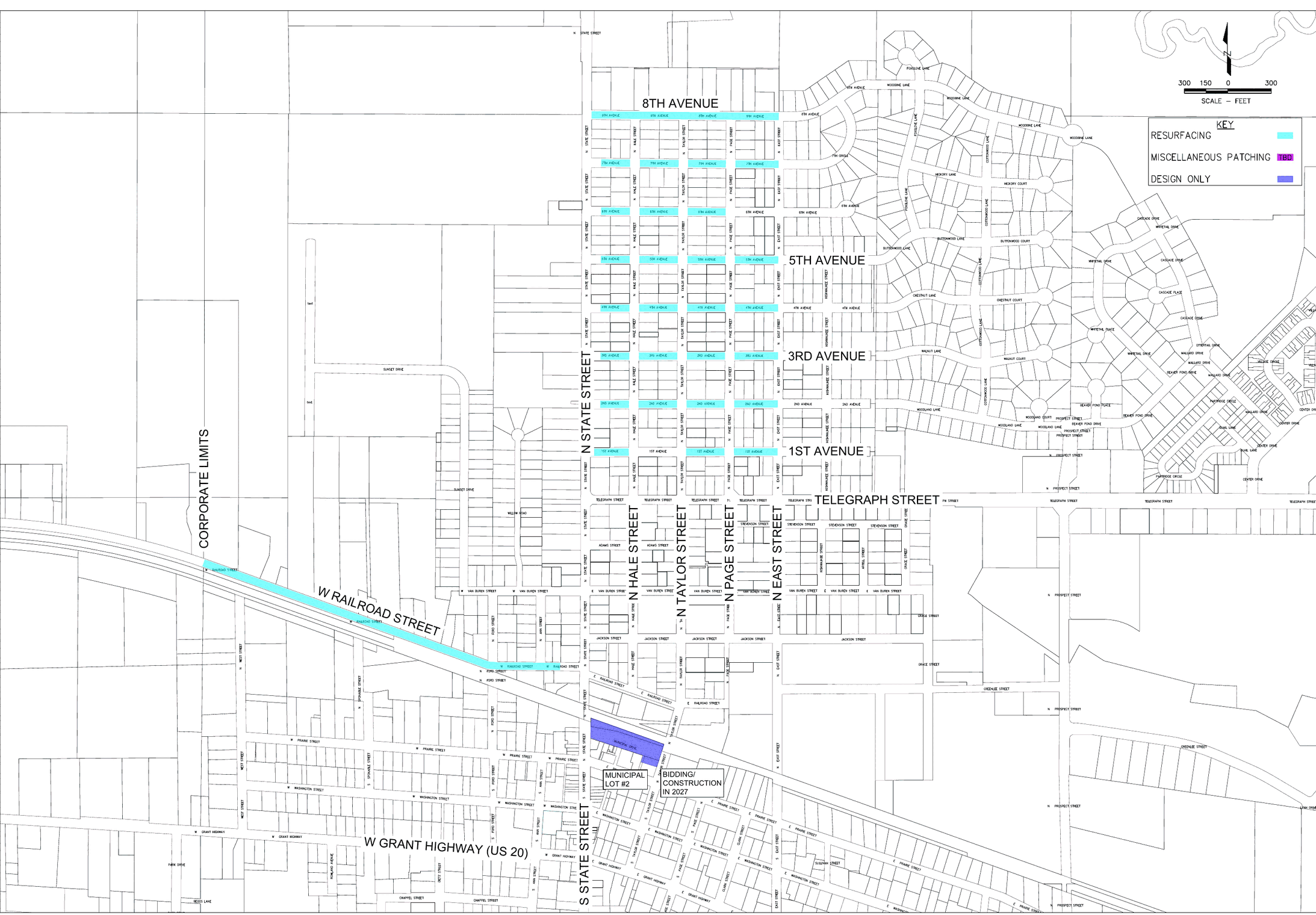
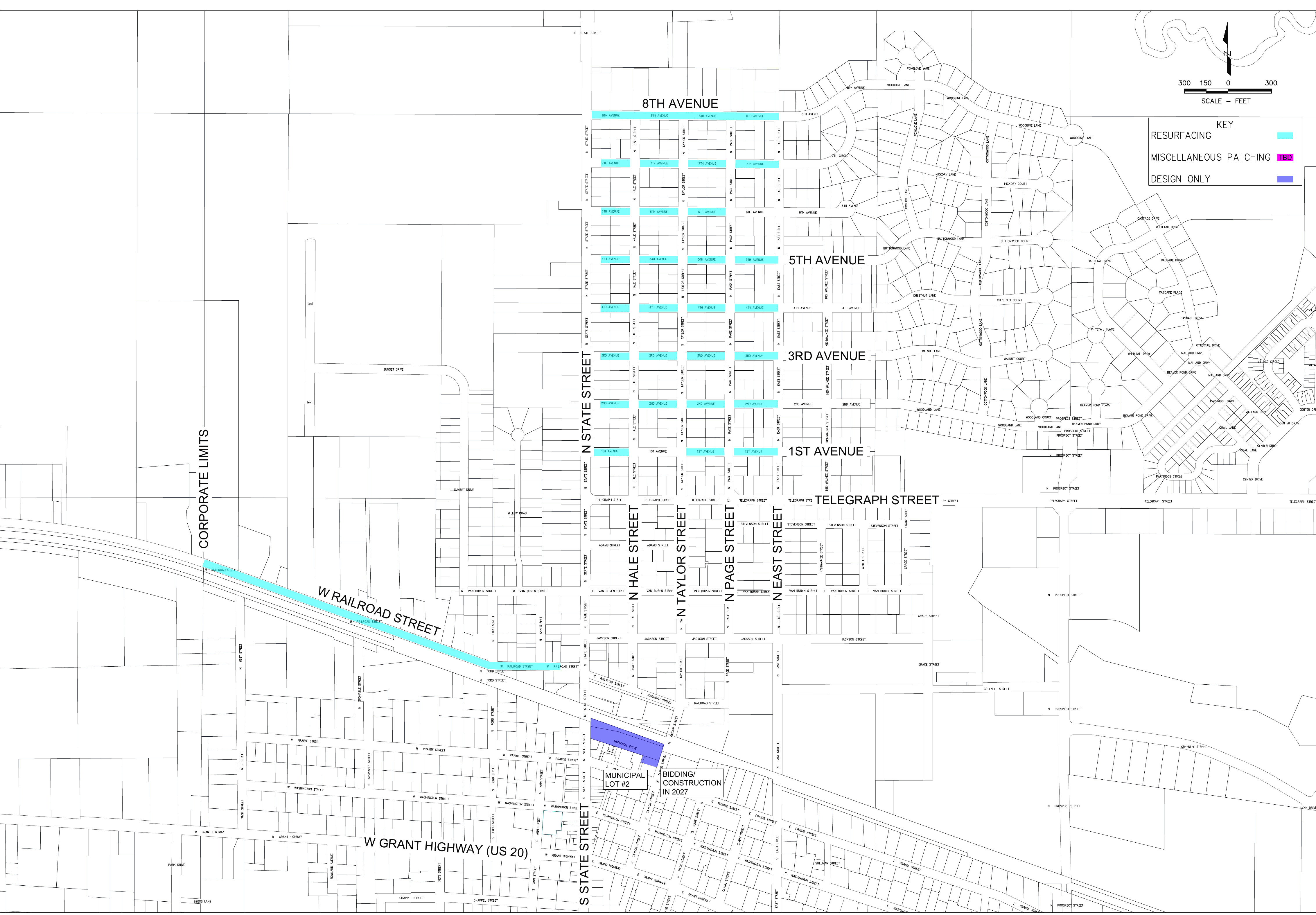
The location map from McMahon Engineering's June memo in the June 8 council packet. Highlighted segments are marked for resurfacing: the numbered avenues between North State and North East streets, plus a stretch of West Railroad Street. The shaded block by the State Street rail crossing is Municipal Lot #2, where only design is funded this year, with construction planned for 2027. View the full-size map.
Spend five minutes in Marengo's Facebook groups and you will find the same reply under nearly every city post: fix the streets first. It is a fair point. Plenty of streets in town are in rough shape, and nobody needs a newsletter to tell them that. What is harder to come by is a plain account of what the city intends to do about it this year, on what schedule, and with whose money. So here it is. Marengo Weekly pulled the council packets, the engineering agreements, and this year's budget to lay out what is planned, what it costs, and who pays. We are not out to cheer the plan or to pick it apart, just to put the whole thing in one place.
Prospect Street Is Almost Done
Start with the project you can already see. The Prospect Street reconstruction, the city's biggest street job in years, entered the year in its final stretch. In January, then-public works director Chad Roscoe told the council the project was about 80 percent complete and expected to wrap up in July 2026. By late April it was down to finishing touches: Mayor Proffitt told the council on April 27 that striping was set to go down the next day, weather permitting.
Prospect was never a city-only job, which is part of why it took the shape it did. The council's December 2024 approvals sketch the partnership: an intergovernmental agreement with the State of Illinois, funding resolutions drawing on both the city's Motor Fuel Tax allotment and state Rebuild Illinois money, a crossing agreement with Union Pacific for the Prospect Street rail crossing, and a $340,014 construction engineering contract with Baxter and Woodman, subject to IDOT review. What remains in this year's budget is mostly money changing hands. This year's budget, presented April 13, carries $290,000 in Motor Fuel Tax funds for the remaining Prospect engineering and construction payments, and projects $339,744 in spending on the crossing project against $544,628 expected back in reimbursements.
The Avenues Are Next
The next project is aimed at the neighborhood north of Telegraph Street. On June 8 the council approved a $94,100 engineering package with McMahon Engineering for the 2026 Pavement Maintenance Program: $47,200 for design, $3,900 for bidding, and $43,000 for construction engineering. McMahon's memo to the city describes about 2.3 miles of resurfacing with a construction budget of about $750,000, paid for out of the city's 1 percent sales tax. One note inside those numbers: the design fee also covers a resurfacing plan for Municipal Lot #2, a city parking lot whose construction is scheduled for 2027, and the memo assigns that piece to tax increment financing funds, not the street money.
The program map shows the work concentrated in the avenue grid: resurfacing segments along the numbered avenues, First through Eighth, roughly between North State Street and North East Street. The program also folds in storm sewer and inlet repairs, sanitary spot repairs, and pavement patching where recent water main breaks tore up the road, at locations staff were still finalizing as of the June memo.
Timing is the open question. McMahon's June memo, written before the council approved the work order, anticipated a construction contract in July, paving in August and September, and final cleanup in October. Those dates were the engineer's estimates, and the first one has passed: no contract was awarded in July, and no paving contract appears on the August 10 agenda. As Marengo Weekly reported after the July 27 meeting, the road program was expected to head to bid soon. For a sense of how that pipeline runs: the city's sewer lining project went out to bid, opened bids August 4, and lands on Monday's agenda as a $629,578.25 contract award. The street program has not yet reached the award stage, and the next regular meeting where a paving contract could appear is August 24.
Railroad Street Waits on What Is Under the Asphalt
Railroad Street is drawn on the program map too, a long stretch of West Railroad marked for resurfacing. But the council has held off committing money to it. At the June 8 meeting, aldermen asked for core samples of Railroad Street first, to find out what the road is actually made of before deciding how to fix it. That request appears in Marengo Weekly's June 8 recap; the official minutes, which summarize discussion rather than transcribe it, do not mention it, but the draft minutes for July 27 have Mayor Proffitt confirming the sequence: samples first, then a funding decision. Core sampling itself is routine. McMahon's memo has pavement cores being taken across the program during design to establish what the roads are made of; what the council's request does is put Railroad's answer ahead of any spending commitment.
There is also a truck question hanging over Railroad Street. During the April 27 discussion of closing Route 23 downtown for the Settlers' Days festival, then-acting police chief Andrew Kjellgren told the council that farmers had raised concerns about running equipment down the narrowed Prospect, where the minutes record him putting the roadway at only 11 feet wide, and that closing the truck route would leave Railroad Street and West Street as the only alternatives, with open questions about whether oversize and overweight vehicles can legally use them. What Railroad Street is built to carry is a live question, and the core samples are how the city finds out what kind of repaving job it would be buying.
Where the Money Comes From
Street money arrives in separate pots. The Motor Fuel Tax fund, the city's share of the state gas tax, is largely committed this year: per the April 13 budget presentation, $290,000 goes to the remaining Prospect payments, $100,000 to road patching and safety materials, and $134,450 to debt service. In May the council passed its annual Motor Fuel Tax resolutions, $160,000 for maintenance projects under the Illinois Highway Code and $134,450 to retire Motor Fuel Tax bonds. The avenue resurfacing runs on a different pot entirely: a 1 percent sales tax the city adopted in March 2024 specifically for local street work.
And some roads in town are not the city's to fix at all. Route 20 is a state highway; a resident asked about its west end at both the April 27 and June 22 meetings, and repaving it is IDOT's call, not city hall's. The roadwork underway on Maple Street is the county's, per a council report on July 13.
What to Watch
If you live on the avenues, the signal to watch is a construction contract on a council agenda, most likely August 24; paving would follow in the weeks after, with cleanup running into fall. If you drive Railroad Street, the core samples decide what happens next, and no money is committed yet. And the program is about to get new leadership: on July 27 the council approved Mayor Proffitt's appointment of Tyler Ankney as public works director, filling a post that has sat empty for months, and the job starts August 10, the same night the council meets next.
Marengo Weekly reviewed the June 8 council packet, including McMahon Engineering's work order and program location map, the August 10 meeting packet and the draft July 27 minutes published in it, the FY 2026-27 budget presentation recorded in the April 13 minutes, city council minutes from December 2024 through July 2026, and Marengo Weekly's own meeting recaps for this article.
Update (August 24, 2026): The council awarded the 2026 Pavement Maintenance Program contract on August 24, to Schroeder Asphalt Services of Huntley. Bids were opened August 19 and four companies bid; Schroeder was the lowest at $623,682.80, under both the roughly $750,000 construction budget McMahon's June memo projected and the $765,292.40 engineer's estimate for the bid. The vote was unanimous, with one council member absent.
Railroad Street is in the awarded work. The contract covers the avenues between Illinois 23 and East Street from Illinois 176 to 8th Avenue, plus West Railroad Street from the Ford Street intersection out to the city limits. The core samples were taken during design and determined which blocks get full-depth reconstruction rather than a resurfacing: McMahon told the council those are 7th Avenue, portions of 5th and one block of 3rd. Sewer cleaning and televising also turned up a pipe blockage on one block of 7th Avenue, and the contract carries a repair item for it, to be used only if public works cannot clear it in house. Sidewalk work under this year's program is minimal and generally limited to West Railroad Street at the Ann and Ford Street intersections, and only the roadway is being resurfaced, not the parking areas alongside it.
Completion is set for October 30. The contract is unit priced, so the final cost can land above or below the bid.