Government
Marengo Is Taking Down Nineteen Trees. Here Is Where They Are.
The short version: The council approved $32,161 to take down trees on city property. The estimate lists them by address, so we mapped it: nineteen trees at fourteen places, seven of them within about 900 feet of each other on the southwest side. Nothing goes back in their place, and the city says its own code bars a resident from planting there either. That code is not an accident. Marengo used to replant, and in 2016 the council closed the parkway to it.
Tuesday, August 18, 2026
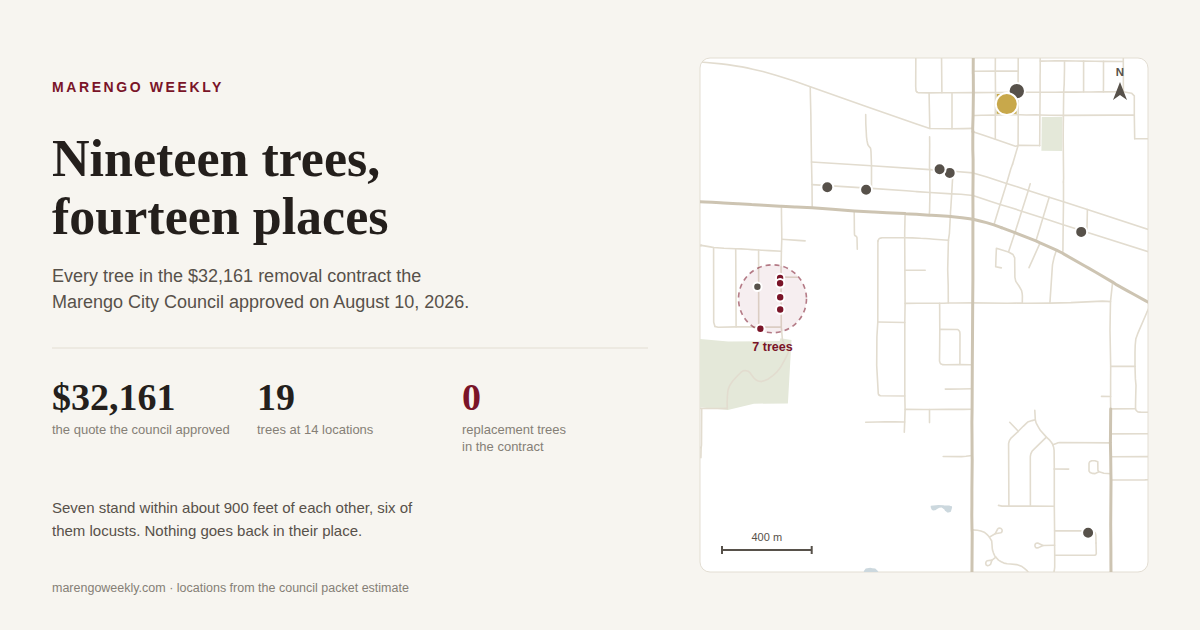
The Marengo City Council voted unanimously on Monday, August 10, to spend $32,161 taking down trees on city property, most of them from the strips of grass between the sidewalk and the street in front of people's houses. The contract goes to Minnihan's Tree Service of Garden Prairie, and it covers removal, stump grinding, and putting the ground back.
The estimate attached to the agenda lists each tree by address, and names the species of every tree outside the park. So we mapped it.
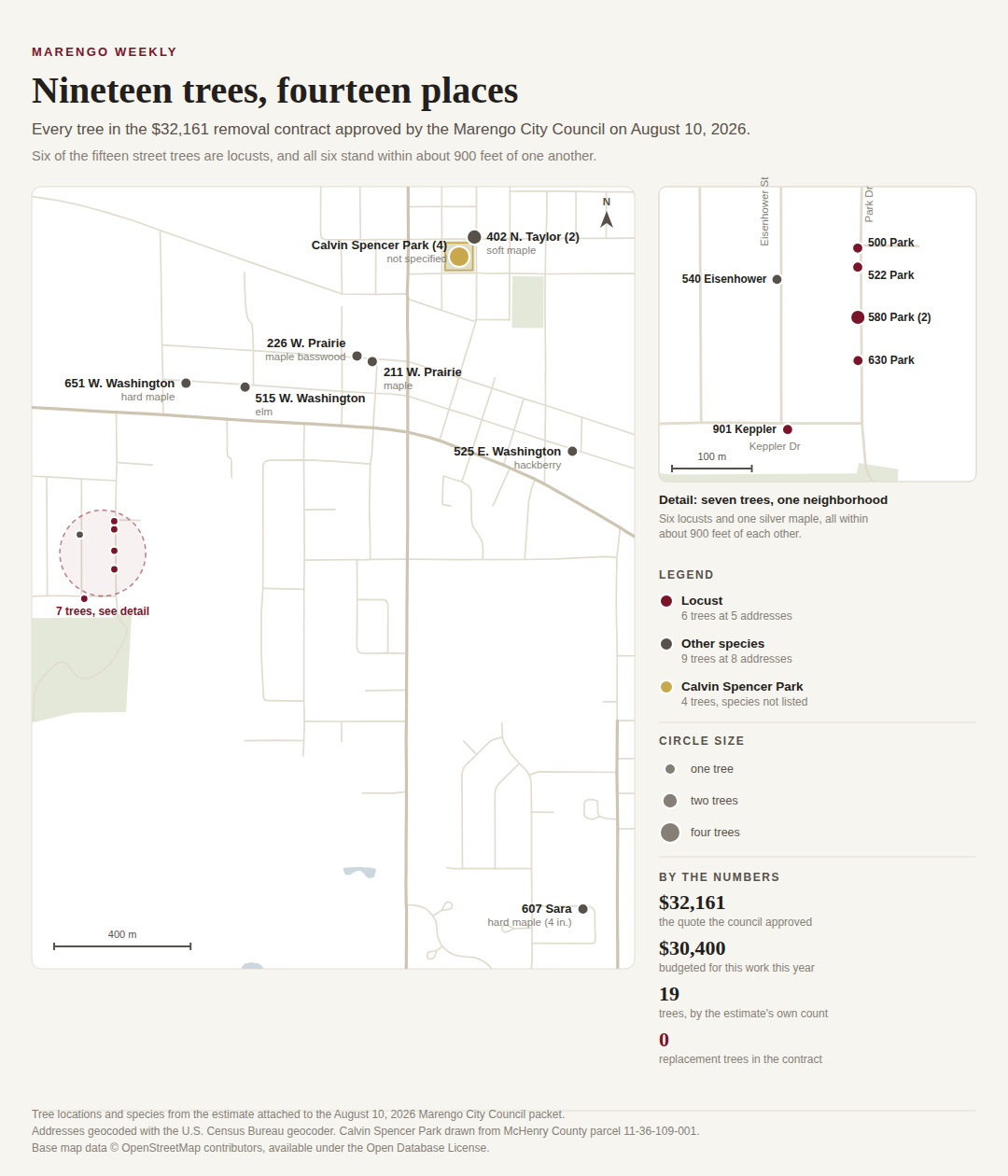
Every tree in the contract, drawn from the estimate in the August 10 council packet. Click or tap the map to open it full size.
Where They Are
Nineteen trees at fourteen locations. Fifteen of them stand in the public right-of-way at thirteen addresses across town, and four more are inside Calvin Spencer Park, the 1.6-acre parcel just north of downtown that the city owns and maintains.
The species read like an inventory of an older Midwestern town: silver maple, soft maple, hard maple, elm, hackberry, basswood, and a lot of locust. The four in the park are the exception: the estimate bills them together, as four trees marked in Calvin Spencer Park, and never says what they are. The cheapest tree on the list is a four-inch hard maple on Sara Lane at $100. The most expensive single tree is a large soft maple on North Taylor Street at $3,500, one of two coming down at that address.
How a Tree Ends Up on the List
When these trees were picked out the city had no public works director, and City Administrator Derik Morefield said it had no arborist on staff either. He told Marengo Weekly he relied instead on the expertise of Mayor Michael Proffitt and Alderperson Michael Miller, who represents Ward 1, to identify trees "that were creating issues in the right-of-way," giving sidewalk damage and roots above the ground as his examples. The city's own agenda supplement credits the two of them by name, saying the trees were identified "with the assistance of Mayor Proffitt and Alderman Miller."
Mayor Proffitt, answering Marengo Weekly's questions on Friday, August 14, described the same arrangement and put it down to the vacancy. "Due to vacancy of our PW Director, Alderman Miller and I tackled this project together," the mayor wrote. Two of the sites on the list came from the mayor directly: Proffitt specifically identified the trees inside Calvin Spencer Park and the two on North Taylor Street at Van Buren.
Miller, answering on Monday, August 17, described the same work from his side. "A list was compiled through input from the mayor and trees identified by walking and driving through the neighborhoods," he wrote. Asked whether he was acting in a particular role, on a committee or by assignment, he said he volunteered: "I volunteered to assist in reviewing locations and the impact on infrastructure."
Marengo Weekly asked both officials whether they own or hold any interest in property at or next to any of the fourteen locations on the list. Neither reported any. Miller also voted, with the rest of the council, to award the contract he had helped assemble.
The examples Morefield gave are about pavement and infrastructure rather than the condition of the tree, and he offered them as examples and not as the whole standard. Asked directly whether the nineteen were dead, dying or otherwise hazardous, or whether they were picked mainly for the damage they were doing to pavement, Proffitt answered "All of the above," and added sight line hazards, a reason neither the supplement nor Morefield's answer had mentioned. Miller, asked the same question, put the weight on pavement: most went on the list, he wrote, because of damage to sidewalks and the safety concerns that presents, along with sight line concerns. So the list is a mix, and no one has broken it down by number.
There is also a reason to take down a tree that has little to do with the tree. Asked whether the city's exposure to trip-and-fall claims on lifted sidewalks factors into which ones come down, Proffitt answered "Yes." The mayor put the whole contract in those terms when asked what a resident should understand about it: it went to the council "to be proactive with our public infrastructure, and to mitigate potential liability."
It also changes going forward. The council confirmed Tyler Ankney as public works director on July 27, and Morefield said the new director is an arborist who can use that knowledge in identifying trees for removal from here on.
Ankney, asked whether selection will change now that the job has an arborist in it, described a standard that carries much of the old one forward. "Priority will be placed on trees that pose significant liability or safety concerns for the City and its residents," he wrote, and on trees "that interfere significantly with City infrastructure causing those same concerns." What his certification adds is a judgment about the tree itself: he expects to bring "some additional context added from my perspective on what in particular is considered an unhealthy or unsafe tree."
One Neighborhood Loses Seven at Once
The map's clearest pattern sits in the southwest. Seven of the nineteen trees stand within about 900 feet of each other, on Park Drive, Keppler Drive, and Eisenhower Street. Six of those seven are locusts, and they are every locust the estimate names.
The obvious guess is that a stand of trees planted together is failing together. Asked whether a pest, a disease, or a common planting date explained the cluster, Morefield said no, not that he was aware of, and pointed back at the same sidewalk-and-roots standard. He also gave a reason the map looks the way it does. "We try to identify tree removals as close together in physical proximity as we can," he said, to hold down what it costs to mobilize a contractor and move equipment around town.
That explains how the work was packaged, not why these particular seven were candidates. We also asked whether residents on that stretch should expect more removals in the next few budget years, and his answer did not reach that question.
Miller's answer reaches part of it. Park Drive, Keppler Drive and Eisenhower Street all sit inside Ward 1, which Miller represents as one of its two alderpersons, and he told us the locusts were identified by walking through the neighborhood.
What the City Usually Spends
This one contract is close to double what the city spent on its tree account in all of last year, and the increase was planned. Marengo's tree trimming and stump removal line finished the 2025-26 fiscal year at $16,940, up from $10,088 the year before and $10,464 the year before that. The council then budgeted $28,000 for the line this year, more than the line has spent in any year the city's published budget reports cover. That account is not the whole picture: some tree work is paid out of other lines, including grounds maintenance and the cemetery, so the city's total spending on trees runs higher than the tree account alone.
The work has usually come in pieces, and over the last several years mostly to one contractor: John Hellyer, who has been paid about $34,000 across the city's books since 2023, most of it for tree work. The city's published payment records only reach back to 2023, but the relationship is a good deal older than that. The council was awarding tree work to Hellyer & Sons as far back as 2014. Hellyer was one of the four contractors asked to quote this job. He came in third, at $39,778, and lost the work to a company that does not appear anywhere in the city's payment records since 2023.
The contract costs more than that internal budget holds. Staff's own arithmetic in the agenda supplement adds the $28,000 tree line to $2,400 budgeted for general maintenance at Calvin Spencer Park and calls it $30,400. The quote came in $1,761 above that. The park's share is the tighter squeeze: felling the four trees there costs $3,600 and grinding their stumps another $1,000, against a $2,400 line that covers the park's routine supplies and upkeep for the year, from restroom supplies to mulch.
Those four park trees reached the city from outside city hall. In June, under public comment, the minutes record two residents who volunteer with Beautify Marengo having contacted the city about several trees in Calvin Spencer Park they believed should be removed, and having collected three quotes themselves, the lowest at $3,200. Seven weeks later the four park trees were folded into this contract at $4,600. The two figures are not a like-for-like comparison: the $4,600 covers felling and stump grinding for four trees, and the minutes do not say how many trees the volunteers' $3,200 quote covered. The mayor's account puts city hall at the same spot: Proffitt told us those trees were identified "when I was working with the beautification group at Calvin Spencer Park." A Marengo Weekly contributor is also involved with Beautify Marengo, which is why we are telling you where that request came from.
Morefield said neither gap is a problem the city treats as one. "The overall year-end budget is what is most important, not individual line items," he told us, since not every line gets spent to 100% and the money all comes out of the same General Fund. He also said the city does not do budget amendments: "these adjustments are made at the end of the year," with staff watching line items along the way to keep total spending inside the approved budget.
The city's own records show that happening, and they show how much room the gap between the two documents creates. This same tree account was budgeted at $10,000 last year and appropriated at $12,000, then finished at $16,940. In April the council adopted a supplemental appropriation ordinance that reconciled it, listing the tree line $4,940 over its appropriation and the Calvin Spencer Park line $4,391 over its own. That is the mechanism Morefield described, though the city does reach for a formal ordinance at year end to true the numbers up.
The gap is not accidental, and it is not small. On both of these lines, in both of the last two years, the city appropriated exactly twenty percent more than it budgeted: $10,000 became $12,000 and $3,000 became $3,600 last year, $28,000 became $33,600 and $2,400 became $2,880 this year. The headroom the appropriation ordinance gives this contract is a standing margin, not a lucky one.
Assistant City Administrator Megan Lopez added the legal frame a day later. "The City operates under its appropriation ordinance, which establishes the legal authority to expend funds," she wrote. As long as spending stays within the amount appropriated for each fund and goes to authorized purposes, the city "has the flexibility to adjust expenditures between budgeted line items as necessary to balance the fund" at the end of the fiscal year, and those shifts do not necessarily require a formal budget amendment every time a line changes. The limit she names is the ordinance itself: "any adjustment must remain consistent with the purpose and limitations of the appropriation ordinance."
That is worth knowing for reading any Marengo budget document, and it is how Illinois municipal budgets generally work. A line item is a plan, not a ceiling. The ceiling is the appropriation ordinance, and this contract fits inside it. The ordinance the council adopted on July 13 appropriates $33,600 for tree removal and $2,880 for Calvin Spencer Park, $36,480 together, against a $32,161 contract. So the piece of paper that carries legal force has room the internal budget does not.
Why It Was Not Bid Out
The council did not take bids. It voted to waive the bidding process and accept a quote, which is a normal thing for a city to do and comes with a specific rule attached.
The rule is the city's own. Marengo's purchasing ordinance says anything over $25,000 has to go through formal bidding or through a bid waiver approved by the council, and between $10,000 and $25,000 the city needs three quotations. State law points the same direction: for Illinois municipalities under 500,000 people, construction work and public improvements costing more than $25,000 go to the lowest responsible bidder after advertising, unless two thirds of every alderperson holding office votes otherwise, which is not the same as two thirds of whoever is in the room. All eight seats are filled, so that is six votes. All eight members were present and the vote was unanimous. The council took the exception the rules provide, by more than the margin they require, and there is nothing irregular in it.
This is also not the first time the city has thought about how to buy tree work. Marengo has put tree jobs out to bid at least five times since 2014, including ash removals and a right-of-way tree contract in 2019, all of them at dollar figures below this one. Hellyer & Sons won four of those five. The one it did not win went to R & J Tree Service in May 2015.
Staff told the council it asked four local contractors for quotes and took the lowest. We asked what the other three said, because when there is no bid opening, the quotes are the only way for a resident to see that the work was shopped. Morefield gave us all four:
- Minnihan's, $32,161
- Dany, $33,650
- Hellyer, $39,778
- Power Tree Removal, $41,500, for sixteen trees rather than nineteen
The first three quoted the same job: nineteen trees, stump grinding and removal, restoration. Power's number is not comparable, because it priced the sixteen trees the list held at the time and was never asked to re-quote once the job grew. Morefield explained why: Power was already the highest of the four at sixteen trees, so going back "would have only gone higher with the addition of 3 more trees," and he did not want to waste that contractor's time on a quote he knew would not compete. "The key here is that we obtained at least 3 competitive quotes for the same scope of work."
On why the job was not put out to bid at all, Morefield was straightforward that there is no bright line. "I don't know what the 'magic number' is for bidding," he said. Told we planned to quote that sentence, he wrote back to say what he had meant by it. He knows the threshold: over $25,000 requires bidding unless the council waives it. His question was a practical one about where the useful line sits, "at what point does it make sense to go through the process of developing bid specifications and going through the bidding process as distinct from obtaining quotes, since developing bid specifications typically requires engaging an outside resource that could increase the cost of a project." His working rule is that bid specifications belong on work involving engineering or technical detail, and he described the difficulty of producing them: Marengo does not currently have the in-house expertise to write bid specs, so it has to hire engineers or other outside help to do it, which costs money. "So developing bid specs for a project that does not require engineering or technical specifications just does not make practical sense."
What Goes Back
Into these nineteen holes, nothing.
The restoration the city is paying for is grass. The agenda motion and the staff supplement describe it as black dirt, seed and straw; the estimate's own note, attached to a line priced at zero dollars, is narrower, promising that all stump grinding will include removal of grindings and adding dirt and grass seed. Nineteen trees come out and nineteen patches of lawn go in.
We asked whether a replanting plan or a budget line for replacement trees existed anywhere else. "Just restored to grass at this time," Morefield said. "We do not have an active replanting program."
That is true of parkway trees. The words Tree Replacement do appear in the city's contracts, but not for this. The Route 23 sewer and water contract the council awarded four weeks before this vote carries a $15,000 line called Tree Replacement, and a 2024 contract carried one at $25,000. Both are time-and-materials allowances, and every bidder on the job priced them identically, which is what an allowance looks like: money set aside to make good on trees damaged while the work is done, not money to put a tree back where the city took one out.
The city also keeps a small budget line named for beautification and reforestation. It has bought American flags, compost, garbage can liners and flowers since 2023, and no trees. Neither has any other line. Across every bill the city has paid since January 2023, it has not bought a tree.
The city does have a tree ordinance, and it is specific. Section 6.24 of the municipal code governs trees on city property and in city rights-of-way, and reaches private trees as well. It says its intent is "to promote increases in the quality of trees and tree care in the City and to promote increases in tree populations in the City whenever practicable."
On replacement it gives the city a choice, not a duty. The city and its authorized agents "shall have the right, but not the obligation, to plant, prune, maintain and remove trees, plants and shrubs on City property and within any City right-of-way or utility easement, as may be necessary to ensure public safety, preserve and enhance the quality of vegetation, and beautify the City." It also lets the city remove any tree on city property or in a right-of-way that is "diseased or dying, or that poses an irreconcilable threat to a utility or that otherwise threatens the public health, safety or general welfare." Trees taken down because their roots are lifting a sidewalk sit in that last clause, not the disease one.
One subsection is the city's answer for residents. It reads, in full: "Trees shall not be planted in city-owned right-of-way." That was Section 6.24(E) in the code the city posted until this month, and it is Section 153.03(A)(2) in the recodified code that replaced it. We asked Morefield whether we were reading that correctly, since it sits one line under the rule requiring forty feet between plantings and one line above the rules setting how far a newly planted tree must be from a corner, a hydrant and a utility line, which is still where it sits. "That is correct," he said. "Residents cannot plant trees in the parkway." The code is not perfectly tidy on the point: the city's subdivision rules still call for canopy trees along new streets and suggest putting them in the parkway, a requirement written in 2005 and never reconciled with the 2016 ban. Morefield's answer is how the city reads it today.
Put the answers together and the fifteen parkway spots stay empty unless the city fills them, and Morefield said there is no program to do that. The same section that bars residents from planting there leaves the city free to plant if it decides to. The homeowner in front of whose house the stump used to be cannot make that decision.
The City Used to Replant. Then It Closed the Parkway.
None of this is an oversight. Marengo once ran a tree replacement program that residents used, and the council closed the parkway to it on purpose, in stages, over six months in 2016.
It began in June. The public works director came to the council on June 27 asking for direction on that fall's replacement program, carrying three options for replacing trees the city had taken out over the previous few years. He did not get a decision on the options, but he got one on location: the minutes record that it was the general consensus of the council not to plant these trees in the right of way any longer.
The program itself kept running. That October the public works director reported it had drawn thirty-eight requests from residents, and in November he reported the fall planting was complete, with twenty-nine trees in the ground. The minutes do not say where those twenty-nine went.
In December the council made the parkway rule permanent, adopting an ordinance that amended Section 6.24 to prohibit trees being planted in the public right-of-way. The public works director told the council the ordinance would end the practice of planting replacement and new trees in the ROW. It passed seven to nothing.
That ordinance is where subsection E came from, and for nine years the code carried its fingerprint. The section that tells a Marengo homeowner they may not put a tree back was stamped 16-12-7, the ordinance's own number, right in its heading. The recodified code the council adopted the same night it approved this contract drops the stamp. The rule survives, in the same terms and the same position, one line under the forty-foot spacing rule. What the code no longer shows on its face is the year somebody decided it.
What did not survive is the program. Nine years later the city has no replanting program at all, in the parkway or anywhere else, and Morefield confirmed it.
One of the seven who voted for the ordinance was Alderperson Michael Miller, who has represented Ward 1 continuously since May 2016. He is one of the two officials the city credits with identifying the trees coming down now.
Asked about that vote, Miller told Marengo Weekly he recalls the decision being "based on replacement costs as well as the impact to sidewalks." Sidewalk damage is the same reason the city gives for taking the nineteen down now. We also asked whether that reasoning still holds for him with nineteen more trees coming out, and his answer did not reach that question.
What a resident faces going the other direction is a permit. Under the same section, a property owner who wants to take down a tree ten inches or more across, measured at chest height, needs a written Tree and Stump Removal Permit from the city, and in some circumstances has to plant a replacement within twelve months.
Any of this could change, but not soon and not on a schedule anyone has set. Staff describe the recodified code the council adopted the same night as a cleanup rather than a rewrite, and say substantive updates to several parts of the code, trees and landscaping among them, still have to come back to the council on their own. Asked when that one might arrive, Morefield said nothing has been discussed or written about it at this point, and that in his reading those sections deal with trees and landscaping in new development rather than with restoration.
Who Gets Told, and When
The work is paid for entirely by the city. Parkway trees sit in the public right-of-way, and Morefield confirmed that nothing is billed back to the property owner out front.
Whether that property owner hears about it beforehand is less settled. Asked what notice a resident gets before the tree in front of their house comes down, Morefield said he was not sure of the process and was leaving it to the discretion of the new public works director.
Ankney, who inherited that decision in his third week, told Marengo Weekly he is "currently in talks with our contractor to determine the process." He intends to reach residents before anything happens: his stated plan is "to communicate with residents ahead of the removal, stump grinding, and restoration process with an expected service window" for when the contractor may be there. He has not settled how. "I cannot confirm the medium that the communication will be released with quite yet," he wrote, "but I would expect some physical form of communication like a door tag or mailer."
He also left the door open on the thing the rest of this contract closes. Asked whether replanting is something he expects to look at, Ankney said it "is something that I think the City will be having conversations about in the future," and that while the city recognizes "the importance and value of replenishing our parkway trees," it has to put its emphasis and its current funding on resident safety first. That is not a program, and he did not promise one. It is the first time anyone at the city has said the subject is open.
The contract is already moving. Morefield said the executed agreement went back to Minnihan's on the morning of August 11. He did not yet know the contractor's timeline for starting or finishing.
Marengo Weekly asked Minnihan's about its schedule, about the scope of the job, and about whether it had done work for Marengo before. We did not hear back.
A Note on the Count
The staff summary attached to the agenda describes seventeen trees. The estimate under it itemizes nineteen, and bills to grind nineteen stumps.
Nineteen is right. Morefield told us the list grew while the memo sat still: it started at sixteen, was seventeen when he wrote the summary, and reached nineteen when two more trees were added. The number in the summary was never updated to match.
The gap was never money. The price is the same either way and reconciles to the dollar.
Sources: agenda item 5.d and the attached agenda supplement and estimate, August 10, 2026 Marengo City Council packet; written answers from City Administrator Derik Morefield to Marengo Weekly, August 11, 2026, from Assistant City Administrator Megan Lopez, August 12, 2026, from Mayor Michael Proffitt, August 14, 2026, and from Alderperson Michael Miller and Public Works Director Tyler Ankney, August 17, 2026; city bills lists and budget reports, January 2023 through August 2026, with fiscal-year figures taken from the city's own budget reports rather than from bills totals; appropriation ordinance 26-7-1, adopted July 13, 2026; approved council minutes for June 22, 2026, and for June, October, November and December 2016; Marengo municipal code sections 6.24 and 17.07 and the subdivision landscaping requirements in chapter 23; 65 ILCS 5/8-9-1; McHenry County parcel records. Code citations are to the Marengo municipal code as posted on the city website at the time of writing; a recodified code adopted August 10 is being rolled out by American Legal Publishing, and chapter and section numbers have changed: the trees provisions are now chapter 153 and the subdivision landscaping rules chapter 157. Current-code citations are to the American Legal edition current through ordinance 26-5-2, published May 26, 2026, which is what a reader will find today; the city's own former chapter PDFs no longer resolve. Every provision quoted here was checked against both. Tree locations mapped by Marengo Weekly from the estimate, geocoded with the U.S. Census Bureau geocoder, so pin positions are approximate and the addresses are as the estimate lists them. Base map data from OpenStreetMap. A Marengo Weekly contributor is also involved with Beautify Marengo, whose volunteers raised the Calvin Spencer Park trees with the city in June.