Government
Marengo Bet on Two TIF Districts in 2011. Only One Worked.
The short version: The city has been setting aside downtown property taxes since 2011, and the fund has never been bigger. Here is what a TIF district is, what Marengo's two have done, and why the next thing the money buys is a parking lot.
Monday, September 21, 2026
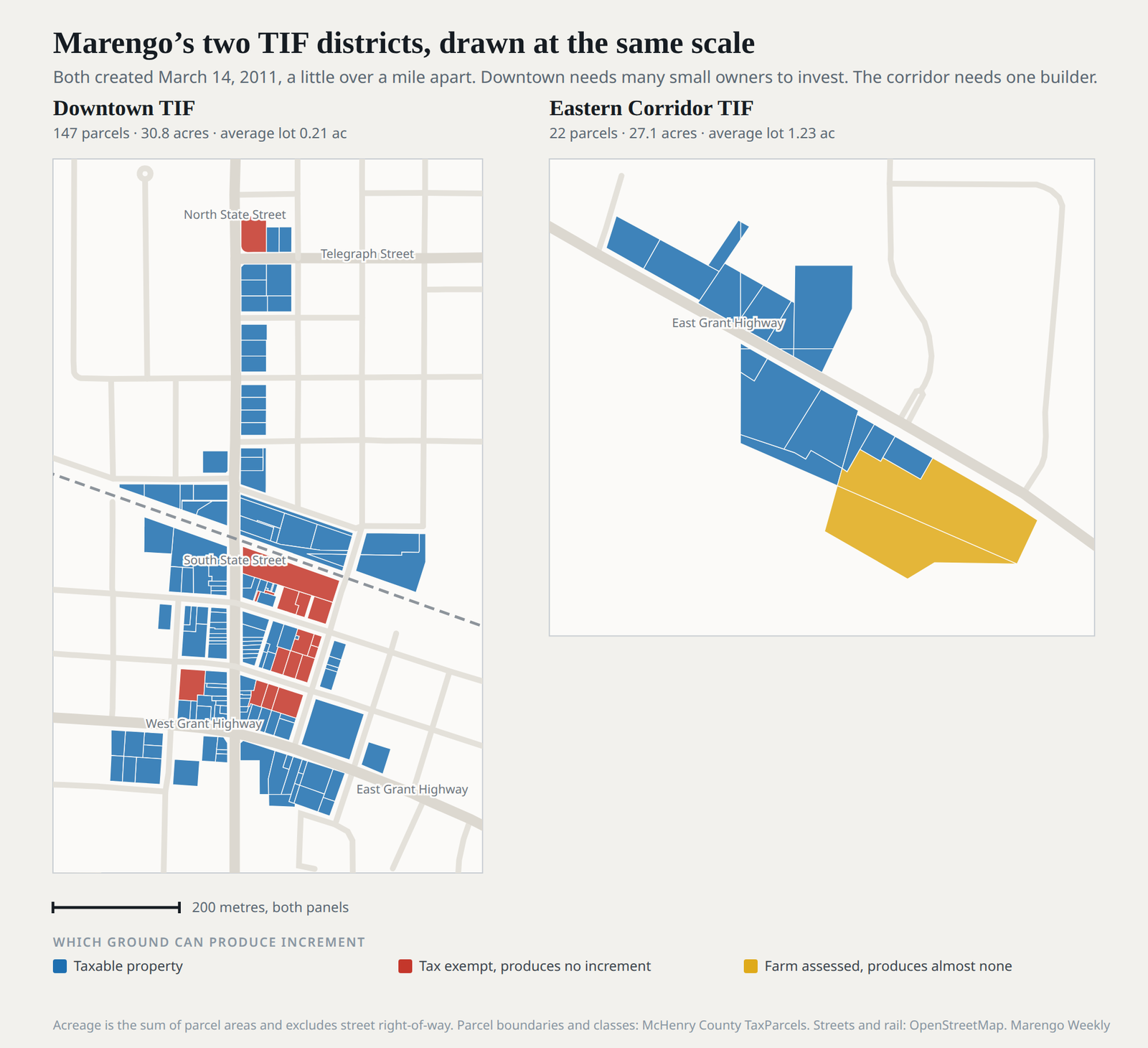
On a Monday night in March 2011, the Marengo City Council passed six ordinances in a row and created two tax increment financing districts, one downtown and one along the eastern end of Grant Highway. An alderman left the room for the votes over a conflict of interest. The mayor read a prepared statement into the record defending the whole idea against months of opposition from the school districts.
Fifteen years later those two districts held about $879,000 between them at the end of July, and the city's own long-range plan describes them as underperforming.
If you have never had a reason to learn what a TIF district is, this is the explainer. Marengo has two of them, they are finally producing real money, and what happens to that money is a live question at city hall right now.
The Frozen Line
When a city creates a TIF district, it draws a boundary and freezes the assessed value of everything inside it at that moment. That frozen number is called the base.
Every taxing body that collects inside that boundary keeps collecting on the base for the life of the district. The schools, the fire district, the library, the park district, the county. None of them lose what they were already getting. That point was the center of the argument in Marengo in 2011, and it is the part people most often have backwards.
What changes is everything above the line. If property values inside the boundary rise above the base, the taxes on that increase do not go to the schools and the fire district. They go into a separate fund the city controls, and by law that money can only be spent inside that district, on redevelopment. The increase is called the increment, and it is what the F in TIF pays for.
The justification is a question planners call the but-for test. The argument is that nobody actually loses anything, because but for the TIF, the growth would never have happened, so the increment would never have existed to divide up. Whether that is true in any particular district is the thing every TIF argument in Illinois is really about.
A district runs 23 years. Marengo's two started in March 2011.
Two Districts, Drawn Very Differently
Marengo drew its two on the same night, and they are not the same kind of animal.
They were also not the city's first try. County records show an earlier Marengo Northside TIF, a single parcel with its value frozen at $184,026 in 2006. It produced $10,250 of increment in its first reported year, then $15,826, then $12,528. Then the parcel's assessment slid back toward the frozen line and the district produced $147, and then nothing at all. The county's reports on it stop after 2011, the same year the council drew the two new districts, and the mayor's prepared statement that night referred in passing to "the one existing TIF."
The Downtown TIF is now 147 separate parcels averaging about a fifth of an acre each. Sixteen of them are tax exempt and can never generate a dollar of increment: six belong to the City of Marengo, six to Marengo United Methodist Church, and the rest to the fire district, the rescue squad, and the Illinois Railway Museum. Another quarter of the district is ordinary housing.
The Eastern Corridor TIF is 22 parcels averaging more than an acre, strung along Grant Highway and reaching into three different townships. None of it is exempt.
That difference decides almost everything that follows. To move the needle downtown you need dozens of separate small owners to each decide, independently, to invest. To move it on the corridor you need one developer to build one thing.
The Downtown District Spent Thirteen Years Underwater
Here is the part that explains the word underperforming better than any other.
Marengo froze both bases at 2010 values, which turned out to be the top of the market. Then the market fell. A TIF produces nothing at all until the district climbs back above its own frozen line, and downtown Marengo took thirteen years to do it.
The county's own parcel reports put the downtown base at $8,385,620. For seven straight tax years, 2012 through 2018, not one of the district's 151 to 153 parcels was worth more than when the clock started. The increment from those parcels was not small in those years. It was exactly zero. From 2014 forward, where the county's records allow the check, every dollar the district did collect came from state-assessed railroad property running through it, not from any building.
The climb is visible after that. County records put the district's taxable value at $6.41 million in 2020 and $7.68 million in 2022. It cleared its own base in tax year 2023, at $8.71 million, and reached $9.86 million in 2024.
You can watch the fund respond. The downtown district collected between $2,751 and $11,779 a year for its first nine reported years. Then $44,038. Then $70,685. Then $132,628.
That was not inaction. It was arithmetic. For most of its life the district was structurally incapable of producing money, no matter what anyone did.
In 2017, when the fund held $13,755, the council looked at spending nearly all of it on downtown sidewalk repair and rejected the bids.
What Actually Turned It Around
The single largest increase in downtown property value in recent years happened at 131 East Prairie Street, the old McGill Building, now D5 Ranges, a 32,000 square foot firearms training facility with a two story shoot house that draws police agencies from across Illinois.
The county assessed those parcels at $14,986 each in 2020. The next year, with construction finished, it assessed them at $267,865 and $204,949. Together with the owner's adjacent lots that is a jump from about $31,000 to about $712,000, which is roughly a sixth of the entire district's growth over the period.
The city helped make it possible. In 2018 the council wrote a new special use category into the downtown zoning district so a shooting range could exist there at all, and in February 2019 it granted the permit on a 7 to 1 vote.
What the city did not do was pay for it. Across the twelve years it has reported figures to the state, the Downtown TIF has spent $5,587.
The other downtown improvements of the last decade were funded from everywhere except the downtown fund. The city put $321,620 of Revolving Loan Fund closeout money into downtown sidewalks and parking lots in 2018 and 2019. It applied for a $30,000 federal block grant in 2020 for a downtown façade improvement program. Private owners paid for the buildings.
There is a straightforward reason for that, and it is not a scandal. Closeout money expires. Federal grants expire. TIF money does not, at least not until the mid 2030s. Spending the perishable money first is what careful budgeting looks like.
But it does leave a real question sitting on the table, and it is the one worth asking now that the district is finally generating six figures a year: what is the fund for?
The Money Can Only Leave Two Ways
A TIF fund is not a general savings account. State law gives the money exactly two exits.
The city can spend it inside the district on redevelopment. Or, if the money is not committed to paying off debt or to anticipated project costs, the law says it must be declared surplus and distributed back out every year to the schools, the fire district, the library, the county and everyone else who gave up that increment.
Each year Marengo tells the state how it splits that balance. For both districts, the answer is that the entire balance is designated for anticipated redevelopment project costs. No surplus is calculated, and nothing goes back. The line item reads, in full, "Restricted for redevelopment project costs."
That is permitted. The law lets a city reserve money for projects it anticipates and does not make it name them. It does mean the downtown balance has been reserved for future projects for years while the fund spent $5,587.
Which Brings Us to the Parking Lot
The city's capital plan has a downtown project in it: a municipal parking lot. In April the council deferred it to the 2027/28 budget year, because the cost estimates came in higher than expected and the district's property tax revenue does not fully arrive until late 2026.
A municipal parking lot is city property, and city property does not pay property tax. So the project cannot generate a single dollar of increment directly. Not now, not ever.
The theory has to be indirect, and it is the standard playbook for a downtown district: fix the public realm, and the private buildings around it become more attractive to own and occupy, and their values rise, and that produces increment. Sidewalks, streetscape, utilities and parking are exactly what a district like this is designed to pay for.
There is also a specific reason parking is the thing. When D5's owners presented to the council in March 2018, the loudest objection in the room was parking, and the minutes record their answer: they planned to make use of the public lot behind city hall. The buildings immediately around them belong to the church and the city and are tax exempt, so there is no private lot nearby to solve it. The district's biggest taxpayer arrived with a parking problem on the record.
One District Used the Tool. The Other Never Did.
It would be wrong to conclude that TIF has done nothing in Marengo, because the other district tells a different story.
In September 2017 the council approved a redevelopment agreement with a developer for the commercial strip center at 20009 East Grant Highway, committing up to $550,000 to be paid back out of the increment the project itself would generate. That is a pay as you go arrangement: no increment, no payment. It is the tool working the way it is drawn up, and the Eastern Corridor has spent about $292,000 over the same period the downtown district spent $5,587.
The eastern district also does something the downtown one does not. Under an intergovernmental agreement signed in October 2011, seven months after the districts were created, it shares part of its increment back with the other taxing bodies each year. The schools, the fire district, the library, the park district, the rescue squad, the township, the county and the community college all receive a share. The downtown district has no such agreement.
What to Watch
Both districts run to the mid 2030s. Neither has ever borrowed against future increment; the annual reports list no debt obligations for either one, in any year.
The downtown fund is now collecting more in a single year than it collected in its first nine combined. The city's treasurer's report for July 31, 2026 shows $480,701 in it, and $398,460 in the eastern fund, $200,000 of it invested. The parking lot is on the capital plan for 2027/28. Any redevelopment agreement, any project, and any decision to spend down either balance goes through a public city council vote.
The next time either district comes up on an agenda, you now know what the money is and where it came from.