Government
Marengo's Giant Solar Farm Was Approved in 2021. The Paper Trail Says It Is Finally Stirring.
The short version: A 300-megawatt solar farm covering more than 2,600 acres around Marengo was approved in 2021, then went quiet for five years. We read the federal grid filings, county land records, and years of local meeting minutes to find out what happened, who owns it now, and which deadlines it is up against.
Tuesday, September 22, 2026
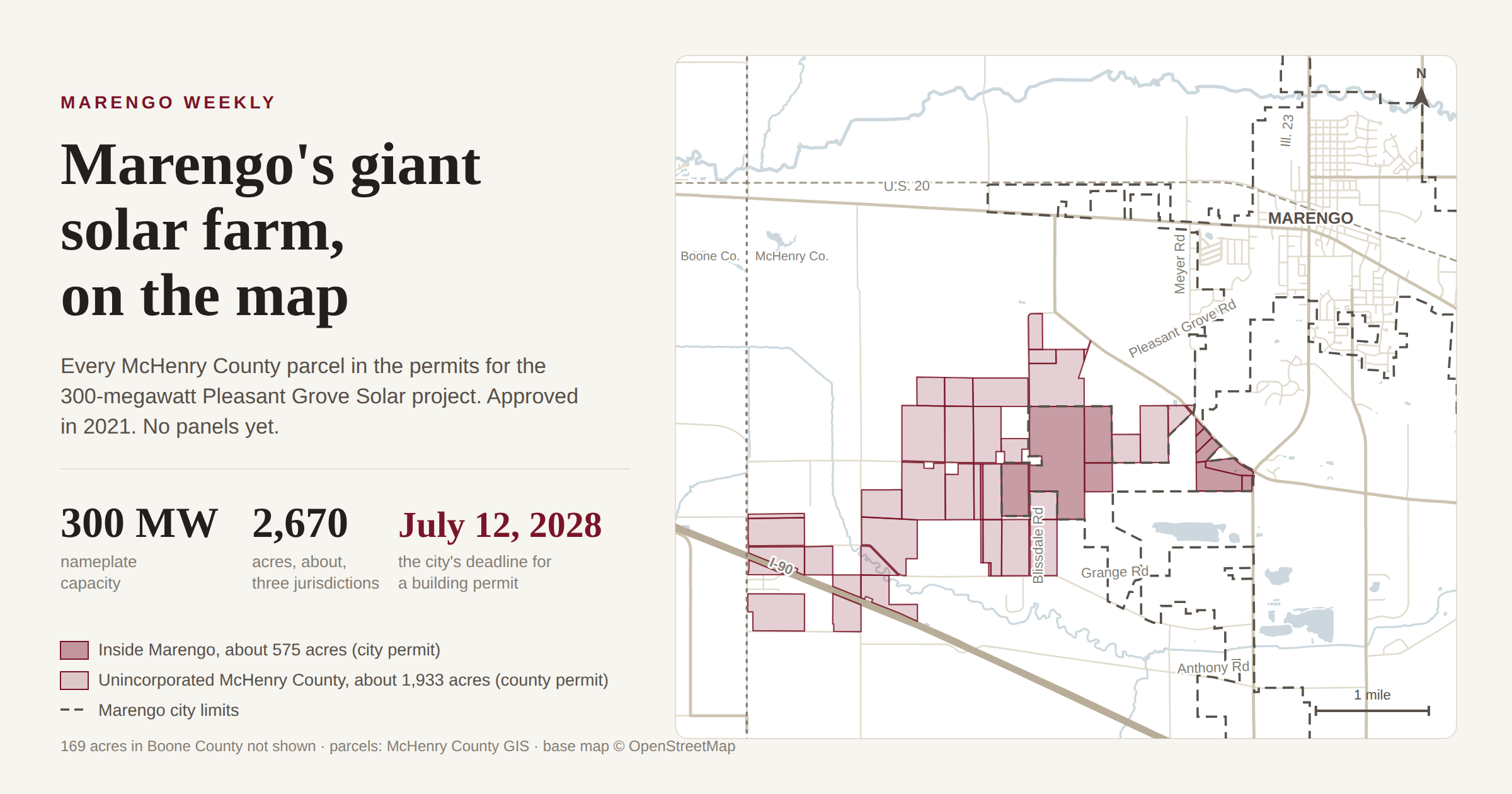
On the evening of April 27, 2026, the Marengo City Council voted 8 to 0 to give a solar company two more years to pull a building permit. As the minutes summarize it, the item passed without public comment, and no news outlet mentioned it afterward.
The company was Pleasant Grove Solar, LLC. The permission it keeps alive is one of the largest solar construction projects ever approved in this part of the county: a 300-megawatt solar farm across roughly 2,670 acres of farmland south and west of Marengo, mostly north of Interstate 90, reaching from inside city limits across unincorporated McHenry County and, as approved in 2021, into a corner of Boone County. When it was approved, its developer told county officials it represented a $450 million investment that would power the equivalent of 60,000 homes.
Then, for almost five years, nothing visibly happened. No panels, no construction traffic, no news. The last time a reporter wrote about the project was the day after Christmas, 2021.
Marengo Weekly spent the past weeks reading everything the project has left behind since: the interconnection agreement on file with federal energy regulators, the county recorder's land records, corporate registrations, and meeting minutes from the city, McHenry County, Boone County, Riley Township, and the Riley school district. The records show a project that is very much alive, owned by a company most residents have never heard of, moving again on paper, and now squeezed between three deadlines that do not line up. The next phase has already begun in the county's zoning file.
What Was Approved in 2021
The approvals came in three pieces, because the project sits in three jurisdictions.
The City of Marengo went first. After an initial cool reception in January 2021 (the council straw-polled against it at the time, per the January 11 minutes), the city granted a special use permit on July 12, 2021, as Ordinance 21-7-1. The ordinance covers ten parcels inside city limits, about 575 acres, and gave the company two years to obtain a building permit. Per the July 12, 2021 minutes, the company was not seeking a property tax abatement from the city, the fire protection district, the library, or the rescue squad.
Boone County approved a special use permit for its roughly 169-acre share in Spring Township in May 2021, on a 10 to 2 board vote. The board added conditions its committee of the whole had worked out that April, including heavy-metals soil testing, vegetative buffers, and a property value guarantee for neighbors.
McHenry County was the main event. Its zoning board of appeals held six hearing dates between July and October 2021 on the roughly 1,933 unincorporated acres. The hearing record, preserved in the board's minutes, is the fullest public picture of the project: panels on single-axis trackers, a 15-foot height cap, a living snow fence of corn rows in place of shrub screening along township roads, a commitment to support re-establishing the Coon Creek Drainage District and to finance cleaning it, and a projected 40-year operating life. Two neighbors spoke against it, citing farmland, wildlife, and Coon Creek flooding. Riley Township Supervisor Karen Schnable, who was also the business manager of the Riley school district, pressed for a drain tile study before any vote. A landowner whose family owns about 410 acres on Jackson Road told the board they had signed a lease, and called the project progress for the county. The zoning board recommended approval 6 to 1 on October 28, 2021, and the county board adopted the conditional use permit on December 21, 2021. Gottemoller moved it with an amendment to the ordinance, Schofield seconded, and the board's vote display recorded 21 yes, none against, and no abstentions. Three members did not vote: two were absent from the meeting and the third was the chairman. The minutes carry the motion but no tally. They list the item under the zoning consent agenda, record that agenda as adopted by voice vote, and give no tally at all.
The township board's objection went further than its supervisor's testimony, and it is on paper. Riley Township released both of the letters it sent the county in 2021 to Marengo Weekly under the Freedom of Information Act. The first, dated April 19, 2021, is eight blocks of questions: whether taxes abated now would land on township residents later, what the project would do to home resale values, who would pay to repair the field tile that construction would cut, whether soil and well water would be tested before and after, whether the panels used cadmium. The second, dated September 22, 2021, asked for one thing plainly. It asked the zoning board to hold the company to the county's development ordinance in full, that "no waiver or variances be allowed," and to finish the drain tile survey before voting. Five weeks later the board recommended approval, corn rows and all.
Something the company committed to at those hearings never materialized. The hearing record includes a road use agreement with the township, the ordinary instrument that settles who repairs rural roads torn up by construction traffic. The county never made it a condition; the conditional use ordinance contains no road use or road repair requirement. In July 2021 a township trustee asked the highway commissioner how the roads would hold up, and the commissioner answered that the company had not approached him yet. By October the zoning board was still waiting on the county and the township for input on roads. In August 2026, asked under the Freedom of Information Act to produce the executed agreement, the township answered in a sentence: "there is no road use agreement."
The township has not gone quiet since. On August 13, as the county gathered agency comments on the substation, the Riley Township Road District wrote to the county zoning board with eleven numbered items it calls initial concerns and a guide for the developer. Several are the township's own permit requirements: an authorization permit after county zoning and before any construction, a construction bond of a size it has not yet set, designated truck routes, and a report from the company's engineers on the type, quantity and weight of the truckloads the build will put on township roads. It asks that Grange and Burma Roads be formally dedicated to the township along the entire parcel boundary, and that the developer fund engineering, design and full reconstruction of those roads at the intersection where Coon Creek floods them shut, sometimes for several days. Highway Commissioner David Diamond notes that no construction traffic is allowed on township roads during the ninety-day spring weight posting, and that the company's planned fourth-quarter 2027 timeline "may need to be modified."
One item on his list is the one the zoning board raised in 2021 and then voted without. Diamond writes that the open farmland proposed for development requires a field tile delineation to keep construction from wrecking the drainage beneath it, and that "it appears that this has not yet been completed." A county water resources engineer, writing to the same committee the same day, put it differently: the applicant had provided a drain tile survey showing numerous existing tile locations, and a further site-specific survey would be required to determine the materials and condition of the tiles. Both documents describe work still outstanding. Diamond's letter is also careful about its own reach: it addresses the substation and switchyard only, and does not cover "previous topics addressed on the solar fields under discussion with Pleasant Grove Solar, LLC/ Deriva."
Two conditions from that county ordinance matter for what came later. The county permit has no time limit of its own. And the decommissioning guarantee, 150% of an engineer's estimate for removing everything, only gets set before a building permit is issued. No building permit has ever issued, so no dollar amount exists.
The township had asked about that risk in writing before any of it was settled. Its April 2021 letter asked the county what would become of the decommissioning obligation if Duke Energy were "acquired or no longer solvent." Nothing in the record answers it. Duke sold the business two years later, and the guarantee still has no dollar amount attached.
Then Nothing Happened, and the Reason Was Bigger Than Marengo
The developer told county officials in 2021 to expect an interconnection agreement with ComEd in early 2023, construction that year, and operations by the end of 2024. None of that happened, and the reason was largely out of local hands.
To sell power, a project this size needs formal permission to plug into the regional grid, which around here is run by a multi-state operator called PJM. PJM's waiting list collapsed under its own weight: federal regulators approved a complete overhaul of the queue in late 2022, and projects that had applied in 2019 and 2020, Pleasant Grove among them, waited years for their turn in the resulting transition process. PJM's own fact sheet from this May says roughly 53 gigawatts of projects now hold signed agreements but are held up by permitting, siting, and supply chain issues. For a project in Pleasant Grove's cohort, signing an interconnection agreement in 2026 is not a sign of trouble. It is the norm.
The city's two-year building permit clock, though, kept ticking. In July 2023, with the deadline days away, the company asked the city for a three-year extension and got 90 days.
That was not the only thing the council did that night. At the same July 10, 2023 meeting, it adopted Ordinance 23-7-2, which removed solar farms as permitted and special uses in every one of the city's zoning districts, and removed utility power producers and facilities as special uses from the agricultural transition district where this project sits. The vote was 7 to 0, with one member absent. The ordinance also rewrote the city's definition of a solar farm to mean one "existing within the City prior to July 10, 2023." The stated reason was blunt. Solar farms "take up a significant amount of property, rendering properties unavailable for more active and beneficial development," and given "the number of solar farm developers interested in encumbering large portions of properties," the council called the amendments a matter of urgent importance.
Pleasant Grove's permit dates to July 12, 2021, which puts it on the surviving side of that line. The city closed the door to solar farms the same night it held this one open.
What happened next is the most local part of this story.
The Land Under the Panels, and the Deal That Kept It Alive
Inside city limits, every acre of the solar footprint sits on land held by one owner: Chicago Title Land Trust number 116642-08, whose beneficiaries are members of the O'Brien family. The city annexed 750 acres of that farmland in April 2013 under an annexation agreement. At the hearing on it, one resident tied the move to hopes for an Interstate 90 interchange, while others questioned the pace of the annexation. In April 2020, the trust leased land to the solar project; the memorandum of that lease is recorded with the county as document 2020R0046793.
By the fall of 2023, with the solar deadline blown, the trust turned the stall into leverage. According to the settlement recitals in the city's December 11, 2023 council packet, the trust's attorney denied the city entry onto the land for water and sewer work serving the Route 23 corridor, and claimed the city had breached the 2013 annexation agreement.
The December 2023 package, adopted 8 to 0 as Ordinance 23-12-7, resolved all of it at once. The trust dropped its claims and gave up its statutory right to disconnect its land from the city, and granted the utility easements the city needed. The city extended the solar deadline to July 12, 2026. The company agreed to pay the Marengo Park District $175,000 under a community benefit agreement, and to reimburse the city's retained personnel costs. The park district money is not owed unless the project happens: the agreement voids automatically if the city never issues a building permit, and says in terms that there can be no assurance the project will ever be built. And the deal drew 400-foot setbacks along Pleasant Grove Road and 500-foot setbacks along Route 23, which the agreement describes as reserving the area for future commercial development: the city, in effect, walling off its most marketable road frontage from the panels.
Closed-session minutes the council voted to release on August 10 show how that payment came to be pointed at the park district rather than at city hall. The minutes are the clerk's summary rather than a transcript, and as they summarize it, then-Mayor John Koziol had asked Duke about giving the city $250,000 a year, and told the council in August 2023 that the company answered it could not, because that would be quid pro quo. Duke's last offer, the minutes record, was $100,000 given back to the community, money that could not go directly to the city. The council discussed sending it to the park district to help with its splash pad, as a community benefit rather than a city benefit. A month later, on September 25, City Attorney David McArdle asked for and received authority to offer the trust a package: amend the annexation agreement so the O'Brien land could not disconnect, secure the easement, and have Duke donate $100,000 for the park district's benefit rather than the city's.
By the time the agreement was signed in December, the figure had grown to $175,000. Nothing in the record suggests anyone did anything improper: the company declined the arrangement it considered quid pro quo, the closure was one the Open Meetings Act allows for pending litigation, and the result was voted on in public.
Koziol, who served as mayor from 2017 to 2025, answered our questions in writing. Asked whether the minutes fairly summarize the August 2023 session, Koziol wrote that the summary "seems fair" and that there was nothing to add. Asked what the request for an annual payment was meant to accomplish, Koziol wrote: "More money for the City for infrastructure improvements." And asked whether quid pro quo was Koziol's understanding of why the company declined, Koziol wrote: "Duke claimed it was quid pro quo."
This past April 27, the council extended the deadline a second time, to July 12, 2028, contingent on a second amended agreement being signed by May 1. The city produced that agreement on August 18, four days after the deadline the Freedom of Information Act allows, along with the ordinance as the council adopted it.
The condition was met. Pleasant Grove Solar's general counsel and secretary signed on April 28 and Mayor Michael Proffitt signed on April 29, both inside the window.
The ordinance that authorized it records something else. Its second recital states that the extension the council granted in December 2023, the one that carried the deadline to July 12, 2026 and that the ordinance describes as having "provided other consideration in favor of the City of Marengo," was never executed: "Inadvertently, the Amended Ordinance and Agreement was never signed by the City Mayor or an authorized officer of Pleasant Grove Solar, LLC." For roughly two years and four months, the document the council authorized, and whatever the city was to receive in exchange for it, sat unsigned by either side. The April 2026 ordinance ratifies it retroactively, dated back to December 11, 2023.
One name sits on both ends of that five-year record. The letter asking Marengo for the 2028 extension, part of the same August 18 production, is dated March 24, 2026, and is signed for the Law Offices of Thomas R. Burney by Carolyn Schofield. In December 2021, when the McHenry County Board adopted the conditional use permit covering the project's unincorporated acres, Schofield sat on that board. The minutes show Schofield seconding the motion to amend the ordinance, and the county's vote display lists Schofield among the yes votes.
Marengo Weekly wrote to ask about it before publishing. Schofield answered two days later: "I was on the McHenry County Board through November 2022. I began working as a consultant with Burney Law mid-2025. I would not have any information on projects prior to that date."
The intervals are the substance of it. County board service ended in November 2022. The work at the firm began about two and a half years after that. The letter followed in March 2026, and the council granted the extension a month later. We also asked whether some rule or guidance applied here that we should be reading, and that question went unanswered. We have found none ourselves: nothing in county policy or in the state law we could locate bars a former county board member from later working for a firm that represents a project the board approved.
Seconding a motion is a procedural step, not sponsorship of what it carries. The county board adopted the permit with 21 members voting yes and none against.
Who Owns It Now
The name on the permits has not changed. The company behind it has. In October 2023, Duke Energy sold its commercial renewables business, development pipeline included, to Brookfield, the global asset manager, in a deal trade press valued at about $2.8 billion including debt. The business was renamed Deriva Energy. Illinois corporate records now list Deriva Energy Solar, LLC as the manager of Pleasant Grove Solar, LLC, at Deriva's Charlotte headquarters address, with the registration active and annual reports filed every year.
The person driving the project has not changed either. Graham Furlong, who led Duke's greenfield development team at the 2021 county hearings, signed the project's interconnection agreement in January 2026 as a Deriva vice president.
The Paper Trail Says It Is Moving
Four sets of records, read together, say this project is not dormant.
The grid agreement is signed and accepted. Deriva, ComEd, and PJM executed the project's interconnection agreement between January 8 and February 2, 2026. It was filed with the Federal Energy Regulatory Commission in March (docket ER26-1617) and accepted by order on May 21, 2026. Under it, the project has posted about $19.1 million in security ($19,122,501, mostly for network upgrades), specifies 75 Sungrow inverters on tracker racking, and commits to a new 345-kilovolt substation, called TSS 971 Prairie, tapping ComEd's existing Silver Lake to Cherry Valley 345-kilovolt line.
The land is still locked up. The county recorder's index shows the original ground leases with area landowners were signed beginning in January 2020 and recorded through that year, and, more telling, that Deriva recorded amendments to those leases with most of the major landowners in the footprint from May 2024 onward, the latest of them in late 2025. What the amendments change is not visible in the free index, and we asked Deriva. But they are recorded legal work, paid for and filed, on keeping the site assembled.
The substation is entering zoning now. In July 2026, Pleasant Grove Solar, describing itself in the application as a wholly owned subsidiary of Deriva Energy, filed a new McHenry County zoning case, Z26-0046, for the substation and switchyard on about 20 acres at Grange and Burma Roads. The application estimates substation construction beginning in late 2027, with the switchyard to be transferred to ComEd after it is built. The county zoning board of appeals has set a public hearing on it for October 14.
Boone County has gone quiet. Boone's board extended its permit in April 2023 and again in April 2024. In the 2024 debate, per Boone's minutes, a board member asked why the project was being sited in Boone when the transmission lines also run through McHenry; a project representative answered that ComEd did not want two substations close together near the Interstate 90 gas plant. The 2026 filings answer the question differently: the substation is now sited in McHenry County, and the federal interconnection agreement puts the generating facility and its point of connection in McHenry.
Boone's own paper trail then stops. The county's 2023 approval letter had set the deadline in a single line: case 02-2021, Pleasant Grove Solar, operational date, May 2024. The board's vote the following April extended the permit past that date, but the county did not produce the term it granted, so how long the current extension runs is not in the record we have. The company's own submission in that file does say, twice, that it would ask for the maximum allowable one year, which would carry the permit to roughly May 2025. What the board actually granted is not in anything the county produced. Boone County released its file to Marengo Weekly and stated that no additional applications for extensions have been received, and nothing about Pleasant Grove appears in its board minutes after April 2024. Nothing in the county's file says the permit has lapsed, and we are not reporting that it has.
Three Deadlines That Do Not Line Up
Here is where the story stops being a comeback and becomes a question.
The city's clock: a building permit by July 12, 2028.
The grid's clock: the interconnection agreement sets its own milestones. At least 20% of major site construction, the grading and roads and pile driving, must be done by December 30, 2028, and the plant must be in commercial operation by September 30, 2029. Read against the city deadline, the timeline only works if construction starts well before the grid agreement requires it. The substation parcel adds its own pinch: per the zoning application, the landowner lease's development term there expires January 2, 2028.
Washington, D.C.'s clock, already expired or already met: under the federal tax law enacted July 4, 2025, wind and solar projects had to begin construction within one year, by July 4, 2026, to stay clear of the termination of the clean electricity production and investment credits, unless they are placed in service by the end of 2027. Pleasant Grove's own grid agreement does not require commercial operation until September 30, 2029, and does not require substantial site work until December 30, 2028, so the federal date and the company's own schedule are pulling in opposite directions. Whether Pleasant Grove started qualifying work by July 4, 2026 is not answerable from any public record we could find: nothing in Deriva's announcements, trade press, or federal generator data shows a construction start, and nothing shows the deadline was missed, either. The answer likely shapes the economics of the entire project.
Marengo Weekly sent Deriva written questions on August 6; the company had not responded by our deadline.
What It Would Pay
The reason every taxing district in the area has a stake in this question is arithmetic. Illinois sets the property value of commercial solar by statute: $218,000 per megawatt, adjusted for inflation, assessed like other commercial property. Marengo Weekly ran the formula for 300 megawatts at this year's actual tax rates for unincorporated Riley Township, taken from a real county tax bill.
The result: roughly $1.8 million a year in property taxes in the project's first year, declining over time with depreciation toward roughly $550,000 a year in today's dollars at the statutory floor. About 67% of that would go to schools. At current rates, the first-year share works out to roughly $728,000 for Riley Community Consolidated School District 18, a one-school district of fewer than 300 students, and roughly $447,000 for Marengo Community High School District 154. The fire protection district, rescue squad, library, township, and county divide most of the rest.
The same farmland today pays somewhere between $50,000 and $150,000 a year across all districts combined. These are our estimates, not the company's, but they are in the same range as the company's own 2021 claim, reported at the time, of $40.3 million over 35 years with $16.8 million to the Riley school district. Our figures are in today's dollars and the company's appear not to be, so the totals are not directly comparable. The split is, and it is the better check: the company put 41.7 percent of the money with the Riley district, and that district's share of today's tax rate is 41.5 percent. A small community solar parcel on Railroad Street in Marengo, taxed under the same formula, comes out within a rounding error of what the statute predicts, which is a further reason to trust the method. No property tax abatement for the project has surfaced in any city, county, or school board record we reviewed. One was discussed early on, and the earliest trace of it sits in the township's minutes. On February 9, 2021, the township board was told that Duke Energy had met with the school districts about a tax abatement involving both Riley District 18 and Marengo Community High School District 154, the two districts in line for the largest shares. Eight days later, the Riley school district's minutes record that the superintendent attended a meeting with the City of Marengo about the Duke leasing project where annexation and "tax abatement or rebates" were discussed, nearly five months before the city granted the permit. Duke's representatives presented to the school board a month later, on March 17. No member of the public spoke that night. The board then discussed what the minutes call "post presentation concerns," returned to the subject once more in April, and took no action on the project in any of the three meetings.
The high school district's record is the same, and it is blunter. Duke Energy sent four representatives, three of them in person, to the Marengo Community High School District 154 board on March 22, 2021. Nobody from the public spoke. The minutes of that meeting record the entire item in one line: "Duke Energy presented on the Pleasant Grove Solar project, no motion taken." The subject came back four more times that year, including a presentation by the superintendent in November on where the project stood, and the board never moved anything. Across sixteen consecutive meetings from December 2020 through December 2021, the word "abatement" does not appear once.
That absence carries weight because an abatement is not a handshake. Illinois law lets a taxing district abate its own taxes only on a majority vote of its governing board, which for a school board means a vote taken at an open meeting and recorded in the minutes. The two districts in line for the largest shares of the money, roughly $1.2 million a year between them at current rates, took no such vote and recorded no decision of any kind about the project in the minutes we reviewed.
What Happens Next
The substation case, Z26-0046, goes to a public hearing next. The county zoning board of appeals is scheduled to take it up at 1:30 p.m. Wednesday, October 14, in the County Board conference room at the county Administration Building, 667 Ware Road in Woodstock. The hearing is open to anyone who wants to be heard, and the county streams audio of its zoning hearings through the meeting portal on its website.
Watching from a distance, it would have been easy to conclude the solar farm quietly died sometime around 2022. The records say otherwise. The land is leased through amendments recorded into late last year, the grid contract is executed with $19.1 million behind it, the substation is in zoning now, and the city has twice chosen, without fanfare, to keep the door open. It is also the only door. Under the code the council adopted in 2023, a solar farm that did not already exist in Marengo cannot be permitted here at all, so if this permit ever lapses the project cannot simply start again. What the records cannot yet say is whether the deadlines, the city's, the grid's, and Washington, D.C.'s, can all be satisfied by the same project. Five years in, that is the question the next two years will answer.
Marengo Weekly reviewed the project's interconnection agreement and related filings in FERC docket ER26-1617 (executed January and February 2026, accepted May 21, 2026); McHenry County zoning records for petition 2021-006 and case Z26-0046, including the December 21, 2021 conditional use ordinance and the 2021 zoning board hearing minutes; Marengo City Council minutes and packets from 2013, 2021, 2023, and 2026, including Ordinance 21-7-1 and the December 2023 settlement package adopted as Ordinance 23-12-7; Ordinance 26-4-4, the executed second amended agreement, and the March 24, 2026 letter requesting the extension, all released by the city under the Freedom of Information Act on August 18, 2026; the city's executive session minutes for August 28 and September 25, 2023, released by the council on August 10, 2026 under Resolution 26-8-A and obtained from the city clerk's office; Boone County Board minutes from 2021 through June 2026; Riley Township board minutes from 2021 and the Riley Township Road District's August 2026 letter to the county; Riley CCSD 18 board minutes from 2021; Marengo Community High School District 154 board minutes from December 2020 through December 2021; the McHenry County recorder's grantor-grantee index for the project's recorded leases, amendments, and ordinances; Illinois Secretary of State corporate records; Illinois Department of Revenue solar valuation publications and actual 2025 county tax bills; and PJM interconnection queue and transition cycle records, for this article.