Government
Marengo Ran Its Police Department Two Officers Short for a Year. It Saved Almost Nothing.
The short version: For a full fiscal year the Marengo Police Department worked with twelve sworn officers instead of the fourteen it is built for. The payroll fell 8.1 percent while the union contract paid a 3.5 percent raise every year. But overtime rose $87,083 over the same span, eating just over 80 percent of the salary savings, and the department's total budget fell 2 percent. The shifts still had to be covered, and sergeants covered them.
Tuesday, September 8, 2026
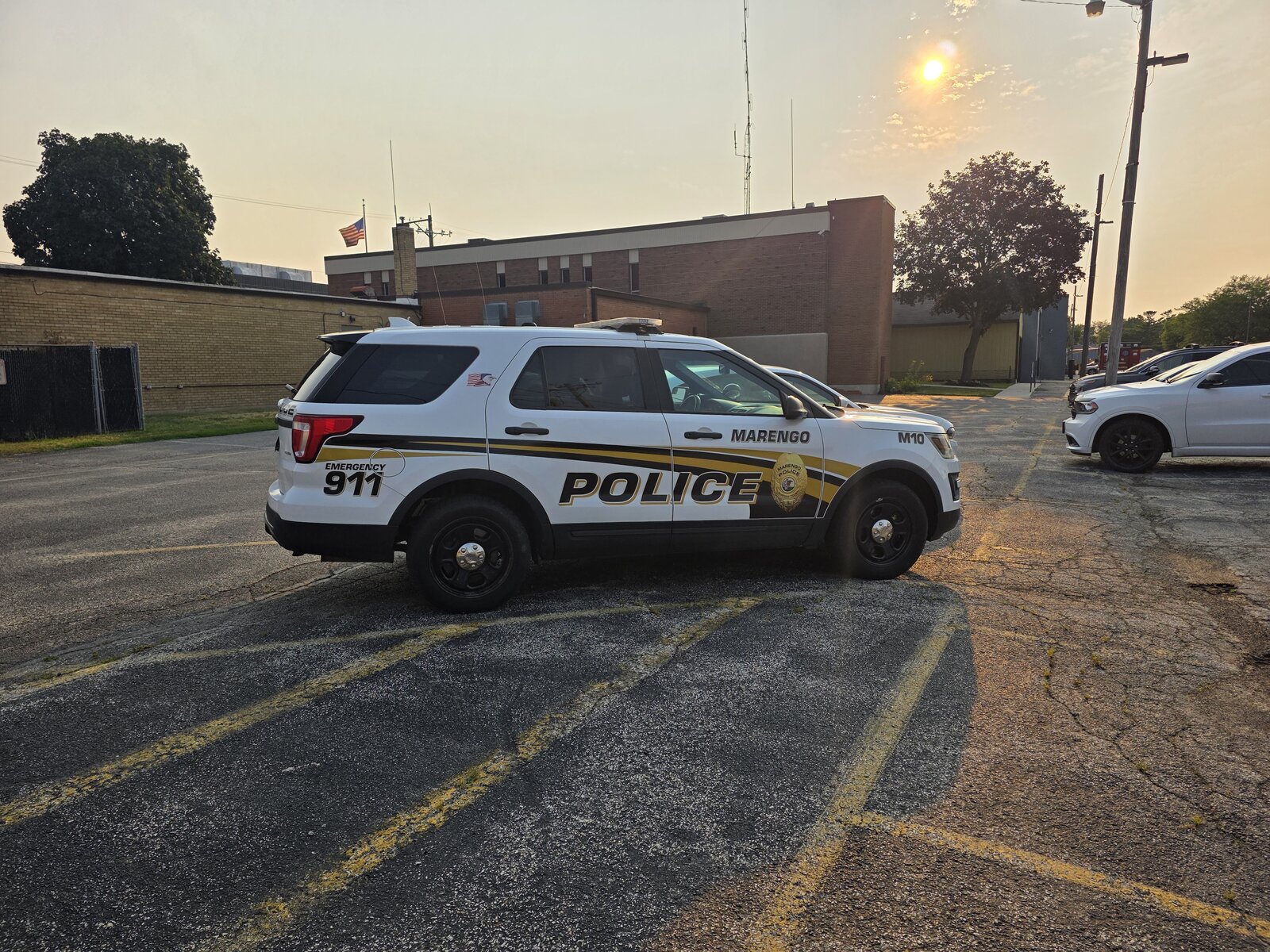
For a full fiscal year, the Marengo Police Department worked with twelve sworn officers instead of the fourteen it is built for. The payroll went down. The city's own budget book shows it: sworn salary peaked in fiscal year 2023-24 at $1,340,728, fell to $1,268,871, and fell again to $1,232,464 in the year that ended this past April 30. That is a drop of $108,263, or 8.1 percent, across two years in which the police contract paid a 3.5 percent raise every year.
Almost none of it stayed saved.
Over the same two years, sworn overtime rose from $126,534 to $213,617, an increase of $87,083. Overtime consumed just over 80 percent of the salary reduction. Put the two lines together and the department's sworn pay fell from about $1,467,000 to about $1,446,000 across two years, a difference of roughly $21,000. The police department's total budget over the same span fell 2 percent.
The shifts did not go away. Somebody worked them, at time and a half.
Where the Officers Went
The city's comprehensive plan, adopted in April 2025, describes the department as "a full-service law enforcement agency with 14 sworn officers and two civilian support staff." In fiscal 2023-24, the year the payroll peaked, it had all fourteen for most of the year.
Then it started losing them.
Officer Sonya Bass retired on March 23, 2024, twenty years and a day after she joined the department, and the council marked it with a special recognition at its March 11 meeting that year. A new officer, Matthew Krueger, was sworn in that August and left for a sixteen-week academy. In September a second officer resigned. The following January a third retired. Neither was replaced that year.
By early 2025 the department was down to twelve, and it stayed there for essentially all of the fiscal year that ended this past April.
The City Kept Saying It Was Trying to Hire
The council minutes are not quiet about this. Across the same two years, two police chiefs reported on hiring at meeting after meeting.
In April 2024, a month after Bass retired, Chief Nathan Hayes told the council he was "working hard to replace Officer Bass's" position and that a candidate was in process. In August the Fire and Police Commission was interviewing to add more names to the eligibility list. In September, when the second officer resigned, Hayes said he would begin working on a replacement. In November he told the council he was working with the commission to get two candidates into the January academy.
None of them arrived. In February 2025 he was "continuing to try and fill the vacancies." In March he was "hopeful they are in the last phase of the new hire." That August, he explained what had happened to the pipeline: "The three candidates we had in process for additional staff all elected to take positions with other police departments."
The pattern continued under his successor. In February 2026, Acting Chief Andrew Kjellgren said he was running background investigations and hoped to bring another officer on by May. In March he reported that the number-one candidate on the eligibility list "has completed all required testing except one remaining component," and that the next two looked promising.
It is now September, and the fourteenth position is still open.
What the City Says Happened
Marengo Weekly asked City Administrator Derik Morefield in writing whether the falling payroll was the result of holding positions open rather than filling them. He did not describe it as a budget decision. The decrease, he wrote, "was primarily attributable to employee retirements, position vacancies, and challenges in filling open positions within the desired timeframe."
Asked what accounted for the overtime increase, he pointed to the same conditions. "As a result of the factors outlined above, current staff have been required to work additional hours and overtime to maintain essential services and ensure operational needs continue to be met," he wrote.
Asked what the staffing level meant for shift coverage day to day, he described the work landing on supervisors.
"That staffing level meant more overtime when earned paid time off was used due to unfilled vacancies," he wrote. "The department is generally charged with the same number of tasks as we always have and as our numbers have decreased, more tasks tend to fall on less people. These are most often assigned to Sergeants who are also responsible for supervising their shift and responding to calls for service."
A sergeant absorbing patrol work is still the supervisor on duty. That is the part of a staffing shortage that does not appear in any budget line.
The Overtime, in Context
Overtime rises for reasons other than vacancies. Court appearances, training that has to be backfilled, special events and extended absences all push the number up, and the budget book does not break out why. It does not break out anything: the city's own budget process asks departments to submit revenues and expenditures only, with no narratives.
The two-year jump is also measured from the department's cheapest overtime year in the six the budget book prints. Sworn overtime ran $138,164 in 2021-22 and $136,661 in 2022-23 before falling to $126,534 in 2023-24, the year the department was fully staffed, and then climbing to $194,576 and $213,617. Measured from 2021-22 the increase is 55 percent rather than 69. Either way the shape is the same, and the cheapest year is also the only fully staffed one.
For the coming year the city has budgeted $200,000 of sworn overtime, less than the department actually spent last year.
What the City Said It Was Doing, and Where
The pressure on the police budget is real and the city has been explicit about it in writing, three years running, in the memo the finance director sends the council before the annual property tax levy vote.
The November 2023 memo put it this way: "Although we have been able to sustain the ability to transfer significant extra funds for the past 5 fiscal years, we have done so in large part by maintaining staffing levels at a bare minimum and keeping operating expenses mostly flat year over year." The November 2024 memo repeats the sentence with the span changed to nine years. The November 2025 memo, rewritten but making the same claim, says the city has transferred supplemental funds to the police pension fund "over the past nine years," and that "this has largely been achieved by maintaining staffing levels at the bare minimum and keeping operating expenses essentially flat."
Two things are worth being precise about. The memos are written by the city's Finance/HR Director, Megan Lopez, and they cover the city's whole levy, not the police department alone. "Staffing levels" is unqualified in all three. The city's own personnel table shows the same squeeze elsewhere: Administration falls from two positions to half a position over the period, and Finance from three to two and a half.
What the memos are unambiguous about is the reason. Each one names the police pension fund as why the levy has to capture everything it can. The statutory minimum contribution the city estimated for the coming year was $819,484 in the November 2023 memo, $858,382 in November 2024, and $877,977 in November 2025.
Marengo Weekly reported in July that the city has paid at least the statutory minimum into the fund every year since the 2018-19 budget, that the fund's funded ratio has moved from about 45 percent to just over 51 percent, and that in March the city dropped an extra $150,000 a year it had pledged in 2023. That pledge always carried the condition "as funds allow." Staff invoked the condition in a budget presentation on March 23, told the pension board, and the council adopted the budget without the payment five weeks later.
The Department Is Not a Small Line
The police department's approved budget for the current fiscal year is $2,683,031, and the transfer to the police pension fund is appropriated separately, in a different department of the budget entirely. Fourteen of the twenty-two city employees whose total compensation exceeds $75,000 work for the police department, and together they account for about 65 percent of that group's compensation. Police Chief Andrew Kjellgren's total package, which the city discloses as salary, health insurance and stipends combined, is $174,330.
Below the chief, the eight employees the city lists as police officers average about $131,000 in total package, with four of them at or above $140,000. Both sergeants are higher still, at $153,767. Those are packages, not salaries.
The Council Authorized Fourteen, Then Twelve, Then Fourteen Again
There is one more place the staffing question is answered in the city's own numbers, and it is in the budget book itself. Its authorized personnel table lists the police department at sixteen positions, fourteen sworn plus two civilian, in every year from 2021-22 through 2023-24. For 2024-25 the figure drops to fourteen. For 2025-26 and the current year it is back to sixteen.
That is the shortfall showing up in the city's own staffing plan, and then being planned back out of it.
The budget adopted this spring raises sworn salary to $1,453,027, an increase of 17.9 percent over what the department spent last year. Morefield confirmed that the increase is a move back toward a target headcount, and put that target at fourteen, the same number the comprehensive plan uses. The city filled one open position, he said, and another opened when Chief Hayes left. It had hoped to have that one filled by September, he wrote, though the city was "met with challenges in the hiring process" and is "hopeful for a candidate with this next round of testing."
Kevin Jacobs was sworn in on January 12, 2026. Zachary Lewandowski was sworn in on April 27. The department is now at thirteen sworn officers, one under its authorized strength.
It has been refilling those positions through a change at the top. Chief Nathan Hayes told the council on January 12 that it was his last meeting, having accepted the chief's job in Cary. Kjellgren, a long-serving officer in the department, was acting chief through the spring and was appointed chief by the council on June 8. A sergeant's promotional examination was given in mid-June and three officers passed it. Roy Amaya was sworn in as sergeant on July 13, the same night Kjellgren took the oath as chief.
What It Takes to Be the Fourteenth Officer
The city has been advertising the job two ways at once. It recruits entry-level candidates, meaning people new to policing or who do not yet meet the requirements for a lateral hire, and at the same time accepts certified entry, or lateral, applications from officers already working somewhere else. In the current round, entry-level applications closed on September 2 and the entry-level test is set for Saturday, September 19. Lateral applications are taken on a rolling basis, with no deadline.
The lateral route is the narrower of the two, and the city's certified entry application packet sets the bar. A candidate has to have spent at least 24 months as a full-time sworn officer in a municipal, county, university or state agency, has to have held the job for a year past the end of probation, has to hold current full-time certification from the Illinois Law Enforcement Training and Standards Board, and has to have left their last department in good standing within the previous twelve months.
Candidates who clear that bar skip the parts of hiring built for people starting out. The packet says qualified lateral applicants are not required to attend orientation or sit the written examination. They still face an oral examination, and the commission may also require a background investigation, a physical agility test, a polygraph, and psychological and medical examinations.
A lateral hire does not start at the bottom of the pay scale either. The union contract places certified entry officers between Step 3 and Step 6 depending on years of sworn service, rank at their previous department and specialty skills, which in the current contract year is $78,699 to $89,503. That is well above the $71,473 an entry-level officer starts at, and it is one more reason the vacancy has not simply been a saving.
Hiring and testing are run by the city's Fire and Police Commission, which appoints officers when the council authorizes it. The lateral application is posted on the city's police department page, and the department advertised the entry-level test on theblueline.com, a recruitment site used by police and fire departments across the suburbs.
Marengo Weekly put four written questions to City Administrator Derik Morefield on August 29, asking about the decline in sworn salary, what drove the increase in overtime, what the staffing level meant for shift coverage day to day, and what the coming year's payroll increase is intended to restore. He answered all four on September 1, ahead of the deadline we set. His answers are quoted above.
Figures in this article come from the City of Marengo's adopted fiscal year 2026-2027 budget book, its published disclosure of total compensation packages over $75,000, the collective bargaining agreement between the city and the Fraternal Order of Police, the city's certified entry application packet, and the minutes of the city council and the police pension board. The budget book's figures for 2025-26 are estimated actuals calculated as of April 30, 2026, before the year's audit.
Correction (September 9, 2026): An earlier version of this article said the fourteenth position was not an entry-level job and was posted only as a certified entry, or lateral, opening, and it treated that as part of the reason the position has stayed open. That was wrong. The city has been recruiting on both tracks at the same time. Chief of Police Andrew Kjellgren told Marengo Weekly that entry-level applications in the current round closed on September 2, that an entry-level test is set for September 19, and that the department advertised it on theblueline.com. The section on what it takes to be the fourteenth officer has been rewritten.