Government
Marengo's Video Gambling Machines Took $3.5 Million Last Year. The City's Share Was $177,000.
The short version: Illinois publishes what every video gaming terminal in the state takes in, town by town. Marengo's machines took $3.5 million from players last year and the city received $176,555 of it. The city code sets no limit on how many establishments can have machines, and the one number that looks like a limit is raised whenever the council approves another license.
Tuesday, October 20, 2026
Last year there were 79 video gaming terminals in Marengo, across fourteen licensed businesses. Players fed them $38.8 million and the machines paid back $35.3 million. What the machines kept, $3.48 million, is what the players lost, net of their winnings. The state taxed about $1.22 million of it. The city's share of that tax was $176,555, and the rest, about $1.04 million, went to the state. The remaining $2.26 million was split evenly between the companies that own the machines and the businesses where they sit, roughly $1.13 million each.
If you have never thought about this, you are in good company. The machines sit in taverns and restaurants and a liquor store, usually five or six to a room, and the money they take is reported to the state every month and posted where anyone can read it. We pulled fourteen years of those reports, read the chapter of the city code that governs them, and went back through the council's own minutes and packets. Here is how it works in Marengo.
How the Money Splits
Illinois legalized video gaming in 2009 and the first Marengo machines went live in 2012. A licensed business can operate up to six terminals. The state taxes what the machines keep, and the town where they sit gets five percent of that figure, which the state calls net terminal income. Whatever is left after tax is split down the middle by law, half to the licensed terminal operator that owns and services the machines, half to the business whose room they stand in.
Net terminal income is the number that matters, and it is worth being careful about. It is money put in, minus money paid back out. It is what players lost.
The other number the state publishes, "amount played," is much larger and means much less. A player who feeds in twenty dollars, wins ten, plays that ten again and loses it has played thirty dollars and lost twenty. Every re-wager counts again. In Marengo last year, amount played was $38.8 million against $3.48 million actually lost, about eleven times larger. Anyone who tells you Marengo gambled away $38 million is reading the wrong column.
What the Machines Take
Here is Marengo's, by year, from the state's reports.
| Year | Establishments | Terminals | Player losses | The city's share |
|---|---|---|---|---|
| 2013 | 7 | 28 | $748,478 | $37,424 |
| 2016 | 9 | 43 | $1,448,983 | $72,450 |
| 2019 | 13 | 63 | $2,132,926 | $106,647 |
| 2020 | 13 | 69 | $1,452,579 | $72,629 |
| 2022 | 13 | 71 | $3,258,115 | $162,906 |
| 2025 | 14 | 79 | $3,478,295 | $176,555 |
Since the first machines switched on in 2012, counting this year through August, players in Marengo have lost $30.6 million and the city has received about $1.53 million of it.
The 2020 dip is the pandemic: the state shut the machines down from March 16 through June 30 that year, and again from November 20 into January.
Two things in that table are easy to miss. The first is that the growth is not mostly more machines. Between 2019 and 2025 the number of terminals rose by a quarter, and player losses rose by 63%. The average terminal took $33,856 in 2019 and $44,029 last year.
The second is that the machines are keeping a larger share of what goes through them. In 2019 they held 8.5% of the money played. Last year it was 9.0%, and so far this year it is 9.4%. On its own that is a small movement. Applied to $38 million, it is not.
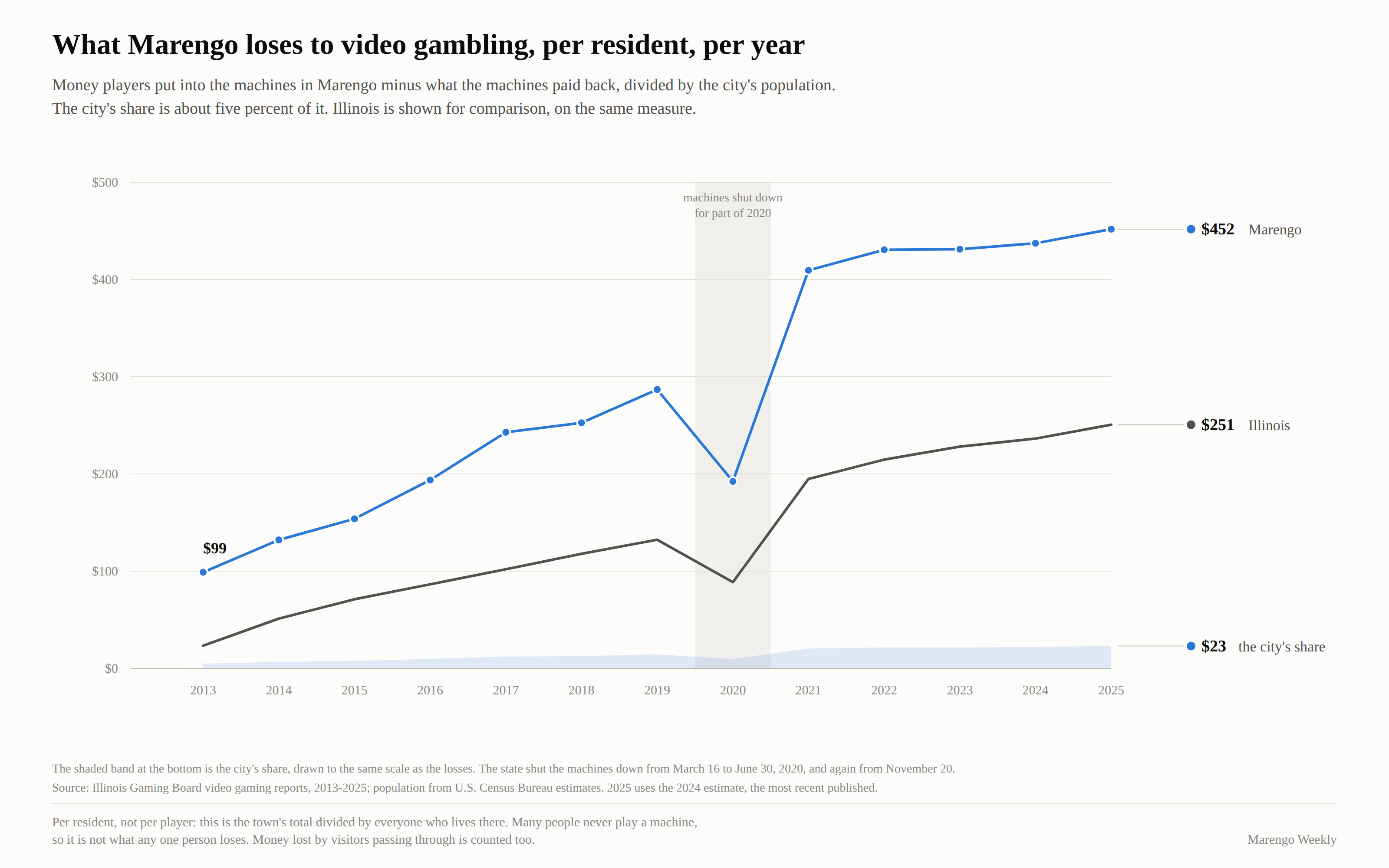
Divide last year's losses by everyone who lives in Marengo and it comes to $452 a year, against $22.93 of it coming back to the city. That per-resident figure needs a caution attached every time it is used, including here: it is a rate per resident, not per player. Many people in Marengo never put a dollar in a machine, so the figure is not what any one person loses, and the state's reports cannot say what a typical player loses. Some of the money is lost by people passing through on Route 20 rather than by anyone who lives here. What the figure is good for is scale, and the scale is that for every dollar the city received last year, players lost about twenty.
Marengo Against Its Neighbors
Statewide, video gaming terminals took $3.19 billion from Illinois players in 2025 and paid local governments $160 million. Spread across the state's population, that is about $251 a resident. Marengo is well above that.
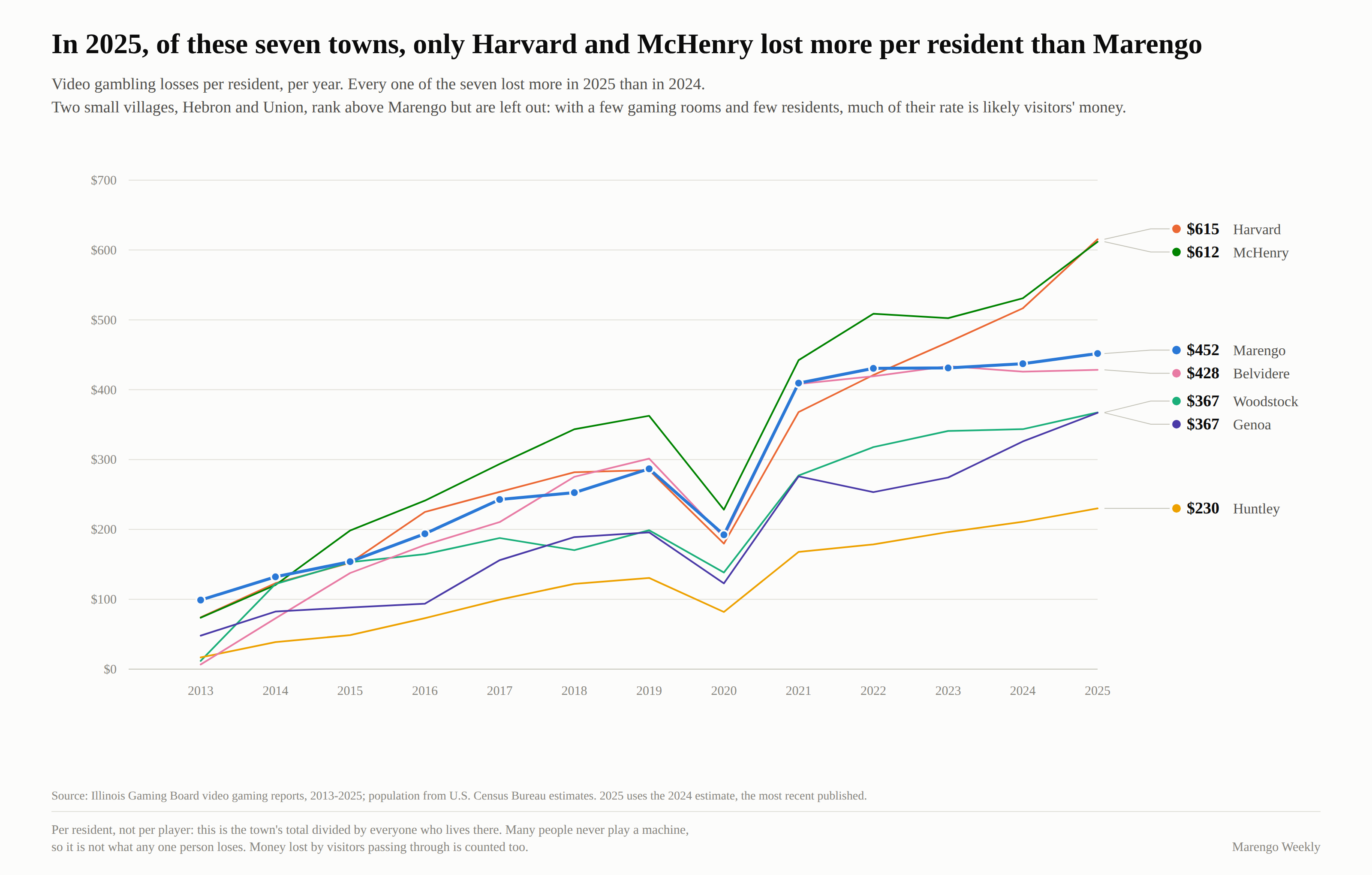
Among seven towns in and around McHenry County, two lose more per resident than Marengo: Harvard, at $615 last year, and McHenry, at $612. Marengo was at $452, Belvidere $428, Woodstock and Genoa $367 each, and Huntley $230. Every one of the seven lost more in 2025 than in 2024, as did the state as a whole, up about 6%. Two smaller places nearby are higher still: Hebron and Union, small villages where a handful of gaming rooms and a small population push the per-resident figure up, and where much of the money is likely lost by people who do not live there.
What the City Can and Cannot Decide
There is no cap in Marengo's code. Section 115.52 permits terminals at any premises licensed to sell liquor, so long as the business follows the state Video Gaming Act and the Gaming Board's rules, files its terminal operator agreement and state license with the city clerk, and pays the city $250 a year per machine, which is the most the Video Gaming Act lets a non-home rule city such as Marengo charge. The section sets no limit on how many establishments in Marengo may have machines. The six-per-business limit is the state's, not the city's.
The one number that looks like a cap is not one. The code caps Class A liquor licenses, the full-bar class both of last year's new gaming locations received, and that number currently reads twelve. But the same section instructs the clerk to raise it: "Upon approval by the City Council of an increase in liquor licenses, the City Clerk is hereby directed to amend this section to increase the number of liquor licenses accordingly." The figure in the code is a record of how many the council has approved, not a ceiling it has set. It falls only when a license is revoked or given up.
Gaming revenue does not count against the license test. A Class A license requires alcohol to be more than 51% of a business's sales. The code then says that for that test, "the term SALES shall not include revenue from gaming activity." A business whose income is mostly gambling could therefore hold the license class built for bars, which allows gaming.
What the city does have is the blunt instrument. The Video Gaming Act says "A municipality may pass an ordinance prohibiting video gaming within the corporate limits of the municipality." Residents have a version of the same power: a petition signed by 25% of a town's legal voters, filed at least 90 days before an election, puts the question of prohibiting video gaming on the ballot, and a majority carries it. Neither has been tried here.
The middle ground, some gaming but not unlimited gaming, is mostly the state's. The same Act says no non-home rule unit "may license, register, or otherwise regulate" the businesses that host machines, or the machines themselves. What it leaves a city like Marengo is its own liquor licenses, since under the Act a bar or restaurant must hold one to host machines.
The city's own code works through that door. It already has one license class written with gaming shut out: Class E, for businesses that host art and craft classes and shows, is labeled "(No Gaming)", and the code says "Class E licenses shall not be allowed to apply or receive video gaming endorsement." The code also lets the city attach terms to any license: "Any and all licenses shall be subject to any restrictions or conditions deemed desirable by the Liquor Commission or the Commissioner." As we reported ahead of the October 12 council meeting, whether that general power could hold off gaming at a single business, when Section 115.52 allows terminals wherever liquor is sold, is a question the code does not answer on its face. Whether a city Marengo's size can go further and fix a number of gaming establishments through its liquor licenses, then stop there, is a legal question neither the Act nor the code answers directly.
The council has gone partway before. In August 2016 it voted 8 to 0 for a six-week moratorium on issuing video gaming licenses while it reviewed its liquor code. That September it created a license class for a single video gaming café, and the minutes record a general consensus not to allow that kind of business downtown, "with no cap on the number of licenses." That café class is no longer in the code.
The question came back nine years later, and the council did not resolve it. Two people had asked the mayor about opening video gaming locations, and the council took it up on July 28, 2025. Two aldermen said plainly that they would not favor adding locations. Another asked whether there was a way in the ordinance to control how many licenses the city can approve, according to the minutes. The minutes record no answer, and no ordinance limiting gaming followed. What the council agreed was that all gaming requests would come before it.
Over the next four months it approved two new ones, each on a split vote. On October 13, 2025, a liquor store that had applied for a package-sale license changed its request to a Class A, which the staff memo said was "for the purpose of obtaining video gaming," and the Class A count went from ten to eleven. That vote was four to three, with one abstention. On November 24, 2025, a couple seeking to build a video gaming café in a long-vacant storefront, alongside a new Dairy Queen next door, got a Class A conditioned on completing the buildout, and the count went from eleven to twelve. That vote split three to three among the aldermen who could take part, with one absent and one stepped aside, and the mayor broke the tie in favor.
A third license decision came this month, through a different class. On October 12, 2026, the council approved a Class B table-service license for Amy's Indian Bistro at 304 S. State Street, and raised the number of Class B licenses from seven to eight. The staff memo said the applicant had been advised "that the City Council is not supportive of the establishment of additional video gaming machines." A council member asked at the meeting whether the license could carry a condition against gaming. It passed seven to one without one. Nothing in the code keeps a Class B holder from applying to the state for machines.
Why the City Says Yes
The case the council hears is a real one. The gaming café's application argued that small towns struggle to attract conventional retail, that a gaming café needs only 900 to 1,200 square feet and so fits storefronts nothing else will take, that it fills a long-term vacancy, and that it brings foot traffic to a quiet strip center. Video gaming money also arrives without a tax vote and without a levy.
The council has used the lever it does have. In January 2023 it raised the per-machine fee from $25 to $250, the state ceiling, on a 6 to 2 vote. Staff told the council at the time that the old $25 fee was raising $1,775 a year from thirteen establishments and 71 machines. The line it sits in went from about $4,500 to roughly $20,600 the following year. By state law the fee is not paid by the business alone: it is shared equally between the business and the terminal operator.
What This Means at a Marengo Address
For the current budget year the city expects $162,000 from the state's video gaming tax and $18,500 from the budget line that carries the machine fees. Against $6.75 million in expected general fund revenue, that is about 2.7% of the money the city has to work with, more than the city expects from liquor licenses and building permits put together. It is real money for a city this size, and it is not the sort of sum that decides a budget.
One last thing the numbers will not tell you on their own. The state counts licenses, not open businesses. One of the fourteen Marengo licenses on the books last year had machines that kept $118 across the entire year, on about $4,400 played, which looks more like a license sitting on a list than a busy room. This year the state's file lists thirteen, and 76 machines. The count is a useful number and it is not the same as the number of places in town where you can play.
Marengo Weekly reviewed Illinois Gaming Board monthly video gaming reports for every municipality in the state from 2012 through August 2026, and the Board's dates for the 2020 shutdowns; U.S. Census Bureau population estimates for 2012 through 2024, with the 2024 estimate used for 2025; Chapter 115 of the Marengo Municipal Code, sections 115.05, 115.07 and 115.52 (formerly Chapter 33, sections 33.05, 33.07 and 33.38); City of Marengo council minutes from August 22 and September 12, 2016, and minutes and packets from January 9, 2023, July 28, August 11 and August 25, October 13 and November 24, 2025, and the packet for, and Marengo Weekly's attendance at, the October 12, 2026 meeting; the city's FY2026-27 General Fund budget as presented to the council on April 27, 2026; and sections 25, 27, 55, 60, 65, 70, 75 and 90 of the Illinois Video Gaming Act, 230 ILCS 40. Per-resident figures, percentages and totals are our arithmetic from those records.