Government
How a Marengo Property Tax Bill Actually Works. We Used One of Ours.
The short version: The rate on a Marengo city-limits tax bill has fallen 39% in ten years, and bills went up anyway. We walked one of our own bills through the whole machine, from the assessor's number to the two payment coupons, to show how that happens and where you can push back.
Saturday, November 21, 2026
The second half of this year's property taxes was due to McHenry County on Sept. 9. The bill we are going to walk through came to $3,313.14, in two installments of $1,656.57. It belongs to one of us, on a small house inside the Marengo city limits: one story, two bedrooms, two baths, a one-car detached garage, no basement, a little over 1,200 square feet, and in need of some work.
One of us is Travis Coudal, who writes for Marengo Weekly and is a candidate for Marengo City Council in Ward 4. Justin Bounds edited and approved this piece, as with everything Travis writes that touches the city.
If you have paid that bill for years without ever quite knowing who decided the amount, you are in good company. A property tax bill is the one piece of local government that reaches every property in town, and almost nothing about how it is built is explained anywhere. So we read the whole thing: the bill, the county's file on the house, the assessment notice that arrived last fall, and eleven years of the county clerk's reports on what every taxing body billed. Here is what we found.
The short version, and the one sentence to keep: the rate on this bill has fallen by more than a third in ten years, and the bill has gone up anyway. It is how the system is designed to work, and once you see the machine, most of the rest of the bill makes sense.
Five words carry the whole thing:
- Levy: the dollar amount a school board, council or other board votes to collect.
- EAV: the county's total of taxable value in that body's territory, short for equalized assessed value.
- Rate: the levy divided by the EAV, shown on your bill per $100 of taxable value. Nobody sets it. The division does.
- Extension: what the county clerk actually bills for a levy, after the cap.
- Equalization factor: a multiplier the county applies to a whole township to bring assessments in line with sale prices.
Nobody Sets a Rate
Start with the thing most people have backwards. No one in Marengo decides your tax rate. Not the council, not the school board, not the county.
What each taxing body decides is a dollar amount: the levy, the total it wants to collect from everyone in its territory next year. The school board levies. The city council levies. The library board, the park district, the fire district, the rescue squad and the township all levy, each by its own vote, mostly in December.
The county clerk's office then does the math. First it adds up the taxable value of every property in that body's territory; that total is the equalized assessed value, or EAV. Then it divides the levy by that total. Levy divided by EAV equals the rate, expressed per $100 of taxable value.
Here is the City of Marengo's own line over ten years, from the clerk's reports:
| Tax year 2015 | Tax year 2025 | |
|---|---|---|
| Total EAV inside the city | $109.2 million | $238.4 million |
| What the city billed (its levy, after the cap) | $1,498,030 | $2,087,433 |
| City rate | 1.376 | 0.892 |
The value of the city more than doubled. What the city collected rose 39%. So the rate fell by more than a third. Nobody cut it. It fell because the same pile of dollars was spread over twice as much value.
Nearly every body on the bill went through the same thing, and the total did too. The combined rate on a city-limits bill was 11.82 per $100 of taxable value in 2015 (the county files bills like this one under tax code 11001). This year it is 7.22. Down 39%.
Who Decides What Your House Is Worth
If the rate is an output, the value is the input that matters.
Illinois law says property is assessed at one third of its fair cash value, and it measures that third with a rear-view mirror: the state's definition of "one third" rests on the sales of the previous three years, not this year's listings. The 2025 assessment on our house is built, in the county's words, "upon sales transactions from (2022-2024)."
The first person to put a number on your house is the Marengo Township assessor, an elected official with an office on Route 23. The number then climbs a ladder: the county, the county's appeals panel, then the state, each with a chance to apply a multiplier. The county's file lists eight steps for our house this year, and they tell the whole story of the 2025 increase:
| Step | Our assessed value |
|---|---|
| 2024 value, carried over | 49,369 |
| Township assessor's number | 49,369 |
| County's number, before its multiplier | 49,369 |
| County's number, after its multiplier | 53,882 |
| Appeals panel's number, before its multiplier | 53,882 |
| Appeals panel's number, after its multiplier | 53,882 |
| State's number, before its multiplier | 53,882 |
| State's number, after its multiplier | 53,882 |
Only one step changed anything this year.
The township assessor did not touch the house. The office carried last year's number, which is normal in a year like this one: assessors are required to revalue everything on a four-year cycle, and in the years between, a county factor is how the roll keeps up with the market. The whole 9.14% increase came at the fourth step, when the county's Office of Assessments applied what it calls a local equalization factor of 1.0914 to every parcel in Marengo Township at once.
Here is why. The county compares three years of actual sales in each township to the assessments on those houses. If the typical house is assessed at less than a third of what it fetches, the county does not send an assessor door to door. It multiplies the whole township up to the line. The county's own sales files bear this out: for the Marengo Township houses that sold in 2024, the assessor's values came to about 26% of the sale prices, not 33%. For the houses that sold in 2025, the multiplier brought the typical one to just about a third.
The assessment notice that arrived last November says as much. The reason column reads, simply, "Equalization." Multiplied, not inspected. And because the increase was "due solely to the equalization factor," our house never appeared in the newspaper's list of changed assessments; the township-wide factor gets a general line in the paper, but no address does (more on that notice below).
There is a second multiplier above that one, the state's. The Illinois Department of Revenue compares counties to each other and issues a county-wide factor; for McHenry County this year it was 1.0000, certified on March 10, and it is the "State Multiplier 1.0000" printed on your bill.
The notice translates the final figure, 53,882, into a "full fair cash value" of $161,660: three times the assessed value, give or take the county's rounding. That is what the county thinks the house is worth. The county's number is not a listing price. It is a three-year average, applied to a house one of us bought for a good deal less than that in 2017.
What Comes Off Before the Math
Before the rate is applied, exemptions come off the value. Ours has one, the General Homestead Exemption, which takes $8,000 off the assessed value of any owner-occupied home in McHenry and the other collar counties. So 53,882 becomes 45,882, and that is the number the rate is applied to.
Two things about that $8,000 are worth knowing.
First, it is not automatic on a new purchase. You apply once, through the township assessor or the county, and it stays. This house's 2018 bill, the last one paid before that application was on file, was $3,227.58; the exemption arrived the next year and was worth about $640 at that year's rate. If you bought recently and your bill looks high, check for the line that says "General Homestead Exemption" and make sure there is a number on it.
Second, it is a fixed dollar amount in a rising market, so it shrinks in relative terms every year. In 2020 the exemption, then $6,000, was 17.6% of this house's value. In 2025, at $8,000, it is 14.8%.
There are more exemptions than that one, and they are worth checking, because each applies only if you ask for it. Homeowners 65 and older get a second $8,000 off. Seniors with household income of $65,000 or less can freeze their assessment where it stands. There are exemptions for people with disabilities, for veterans returning from active duty, for veterans with service-connected disabilities, and a four-year break on the added value of a home improvement. Inside the city, exemptions remove about $27 million, roughly 10% of the city's assessed value, before any rate is applied. Everyone else's rate is a little higher to make up the difference. That is the design.
Where the $3,313 Went
Twelve taxing bodies share a city-limits bill. Here is ours, from the county's own breakdown, largest to smallest:
| Taxing body | Rate per $100 | Our share |
|---|---|---|
| Marengo-Union Elementary Consolidated District 165 | 2.358 | $1,081.96 |
| Marengo Community High School District 154 | 1.630 | $747.76 |
| City of Marengo | 0.892 | $409.29 |
| McHenry County | 0.499 | $228.81 |
| Marengo Fire Protection District | 0.311 | $142.70 |
| Marengo Rescue Squad | 0.300 | $137.79 |
| Marengo Park District | 0.280 | $128.37 |
| Marengo Township Road and Bridge | 0.263 | $120.72 |
| McHenry County College | 0.245 | $112.24 |
| McHenry County Conservation District | 0.177 | $81.16 |
| Marengo-Union Library District | 0.135 | $62.14 |
| Marengo Township | 0.131 | $60.20 |
| Total | 7.221 | $3,313.14 |
The two school districts get 55 cents of every dollar. The city gets 12. The other nine bodies split the remaining third.
Of the city's $409.29, $194.96 is the city's pension and retirement levy, most of it the police pension. That is not a quirk of one house: in the city's 2025 levy, the police pension fund is $830,446 of $2.09 million, just under 40 cents of every city tax dollar, up from about 18 cents in 2015. We looked at the fund's history in July.
The Cap
One more piece of machinery sits between the levy and your bill, and it is why the rate keeps falling instead of holding steady while values rise.
Since 1991, McHenry County and the other collar counties, the ring of counties around Cook, have been under the state's tax cap law, formally the Property Tax Extension Limitation Law. It limits how much each taxing body's bill, its extension, can grow year over year: inflation, or 5%, whichever is less. For the 2025 levies on this year's bills, that number was 2.9%. For the levies being set this fall, it will be 2.7%.
The cap has doors in it. New construction is added on top; a body gets the taxes on a brand-new house without it counting against the limit. Voters can also lift a district's limit by referendum. Inside the city, new property added to the rolls was $22,017 in 2015 and $7,430,163 in 2025, a year with a lot of new rooftops. And voter-approved bond payments sit outside the cap entirely.
The cap is enforced by the clerk, not by the taxing body itself. A council can vote for whatever number it likes; the clerk bills, or "extends" in the county's word, only what the law allows. Districts levy in December, months before the county finishes valuing the year, so requests often land a little above the final cap. The city's reports show this working both ways. For tax year 2024 the council levied $2,020,830 in capped funds and the clerk trimmed it to $1,985,490, about 1.75% less. For 2025, with all that new construction lifting the limit, the council's $2,084,744 went through untouched.
The cap also does not apply to home rule governments, a status that lets a city or county act without many of the state's limits. Marengo is not one, and neither is McHenry County. County voters will see an advisory question on home rule in November; we explained what home rule would change in July.
Why the Bill Went Up While the Rate Went Down
Put the pieces together on our house, using the county's numbers for each year:
| Tax year | Assessed value | Rate | Bill |
|---|---|---|---|
| 2020 | 34,126 | 9.550 | $2,686.12 |
| 2021 | 35,860 | 9.215 | $2,751.46 |
| 2022 | 39,356 | 8.970 | $2,992.14 |
| 2023 | 43,520 | 8.457 | $3,003.82 |
| 2024 | 49,369 | 7.588 | $3,139.26 |
| 2025 | 53,882 | 7.221 | $3,313.14 |
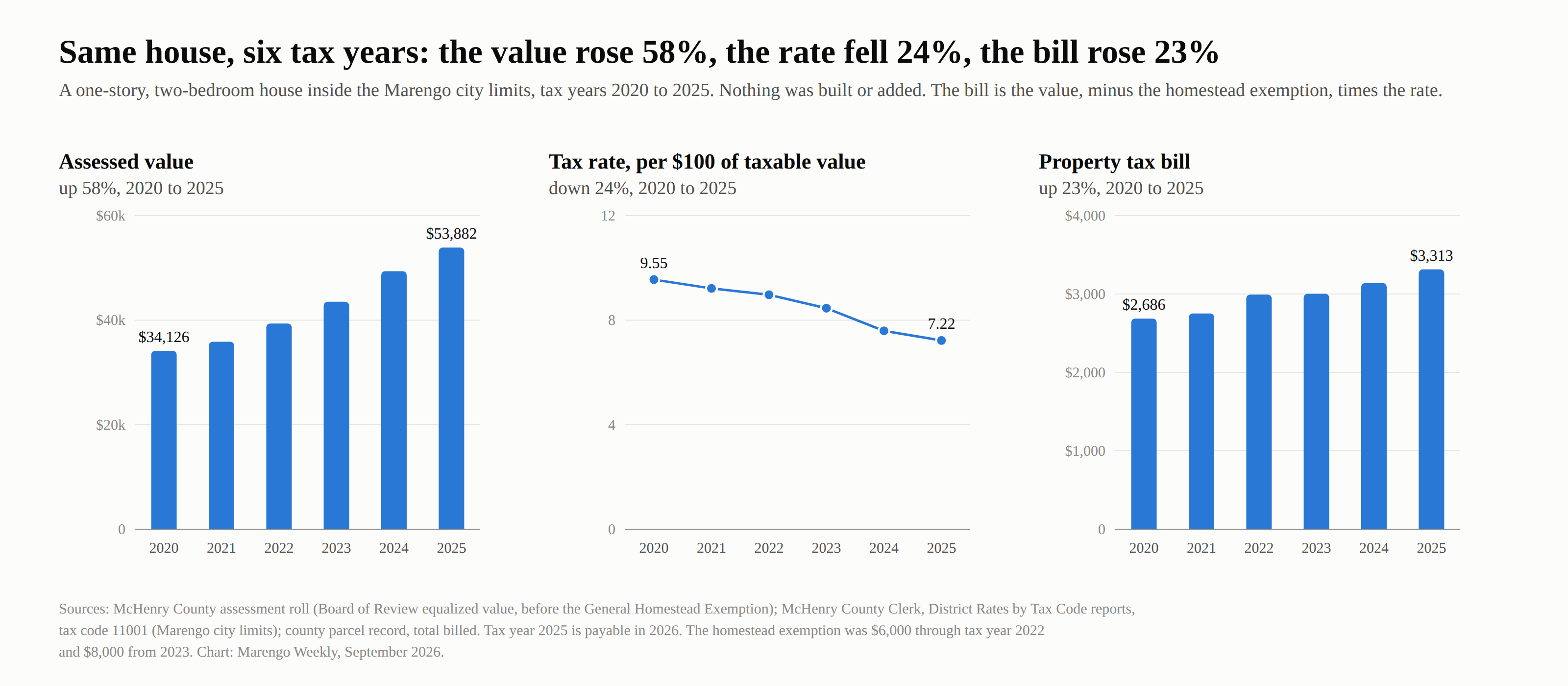
Five years. The rate fell 24%. The value rose 58%. The bill rose 23%. Same house, nothing built. Every line in that table matches exactly: the bill divided by the rate is the value minus the exemption, every year.
The value moved because Marengo sold higher, the county's three-year window caught up, and the township factor did the rest. The rate moved because the levies grew a few percent a year under the cap while the tax base under those levies grew far faster. The bill is what is left when those two forces meet, and in a rising market the value wins.
This is also why two neighbors can see the same rate and bills that move in opposite directions. If your value rose faster than the town's, your bill went up more than average. If it rose slower, less. The rate is the same for every parcel in the tax code. Only the value is yours.
The Calendar, and Where You Can Push Back
The whole cycle runs from a Jan. 1 valuation date to bills due the following June and September, and there are exactly two points along it where a homeowner has a say.
The value. Each year the county publishes assessment changes for each township in the newspaper, for Marengo Township lately in late fall, mails a notice to anyone whose value changed, and opens a 30-day window to file a complaint with the county Board of Review, the appeals panel. For Marengo Township last year, the changes were published Nov. 25 and the deadline was Dec. 26. This year's Marengo Township dates were not yet posted in early October, while several other townships' already were, so watch the county's township filing-deadlines page and the Northwest Herald. Talk to the township assessor first, informally, and early. The notice itself warns that informal reviews get harder to schedule as the deadline nears.
If that does not settle it, file with the Board of Review. If you lose there, you have 30 days to take it to the state Property Tax Appeal Board. Late complaints are not accepted.
The grounds are narrow. You can argue the county has your market value wrong, or that your house is assessed out of line with comparable houses nearby, or that there is a factual error in the record, wrong square footage, a garage you do not have. You cannot argue the rate, and you cannot argue that taxes are too high.
The levy. Between now and the last Tuesday in December, every body on your bill votes its levy at a public meeting. Any body asking for more than 5% over last year's extension has to publish a notice and hold a Truth in Taxation hearing first, a public hearing on the increase, so those notices are the ones to watch for. The city, the schools, the park district, the library and the township vote their levies through November and December. The clerk's early estimate of this year's values, run in August, has the city's total flat at $237.6 million, so there is no wave of new value to spread this year's levies across.
Then the county treasurer mails the bills in early May for the year that just ended, in two installments, in 2026 due June 9 and Sept. 9. A late payment picks up 1.5% for every month or part of a month it is late.
What This Means at a Marengo Address
If your bill went up this year, the most likely reason is the one that moved ours: the county multiplied all of Marengo Township by 1.0914 in the spring, because the town has been selling for more than the assessments said. Nobody voted on that, and it was not the city's call.
If your bill is going to come down, it will not be because a rate fell. The rate has been falling for most of a decade. It will be because a levy stopped growing. That is a decision each board on your bill makes in public, one December at a time. Or it will be because a value gets corrected. That is a case only you can make, in a 30-day window that opens around Thanksgiving.
And if you own the house you live in and have never checked the exemption line, look. It is the cheapest $8,000 in the county.
Marengo Weekly reviewed one contributor's 2025 property tax bill, county parcel record and 2025 assessment notice for this article, along with the McHenry County Clerk's Tax Computation Reports, Tax District Equalized Assessed Value Reports and District Rates by Tax Code reports for tax years 2015 through 2025 and the clerk's August 2026 estimated EAV report; the Illinois Department of Revenue's certification of the 2025 McHenry County equalization factor and its PTELL CPI memos for the 2025 and 2026 levy years; the McHenry County Office of Assessments' township filing-deadline schedules for 2025 and 2026; the county assessment roll and sales files for 2020 through 2025, obtained under the Freedom of Information Act and used only in aggregate; and the Illinois Property Tax Code, 35 ILCS 200. The bill belongs to Travis Coudal, who writes for Marengo Weekly and is a candidate for Marengo City Council in Ward 4; Justin Bounds edited and approved this piece. No individual household other than the author's is identified, and no official was interviewed; every figure is from a public record.