Park District
"No Such Records Exist"
The short version: The Marengo Park District spent $78,500 building a new walking path at Indian Oaks Park. Asked for the contract, the plans, the board vote and any competing price, it answered the same four words six times over. Its own purchasing policy puts anything over $10,000 with the board, and three of the seven invoices clear that on their own.
Thursday, September 10, 2026
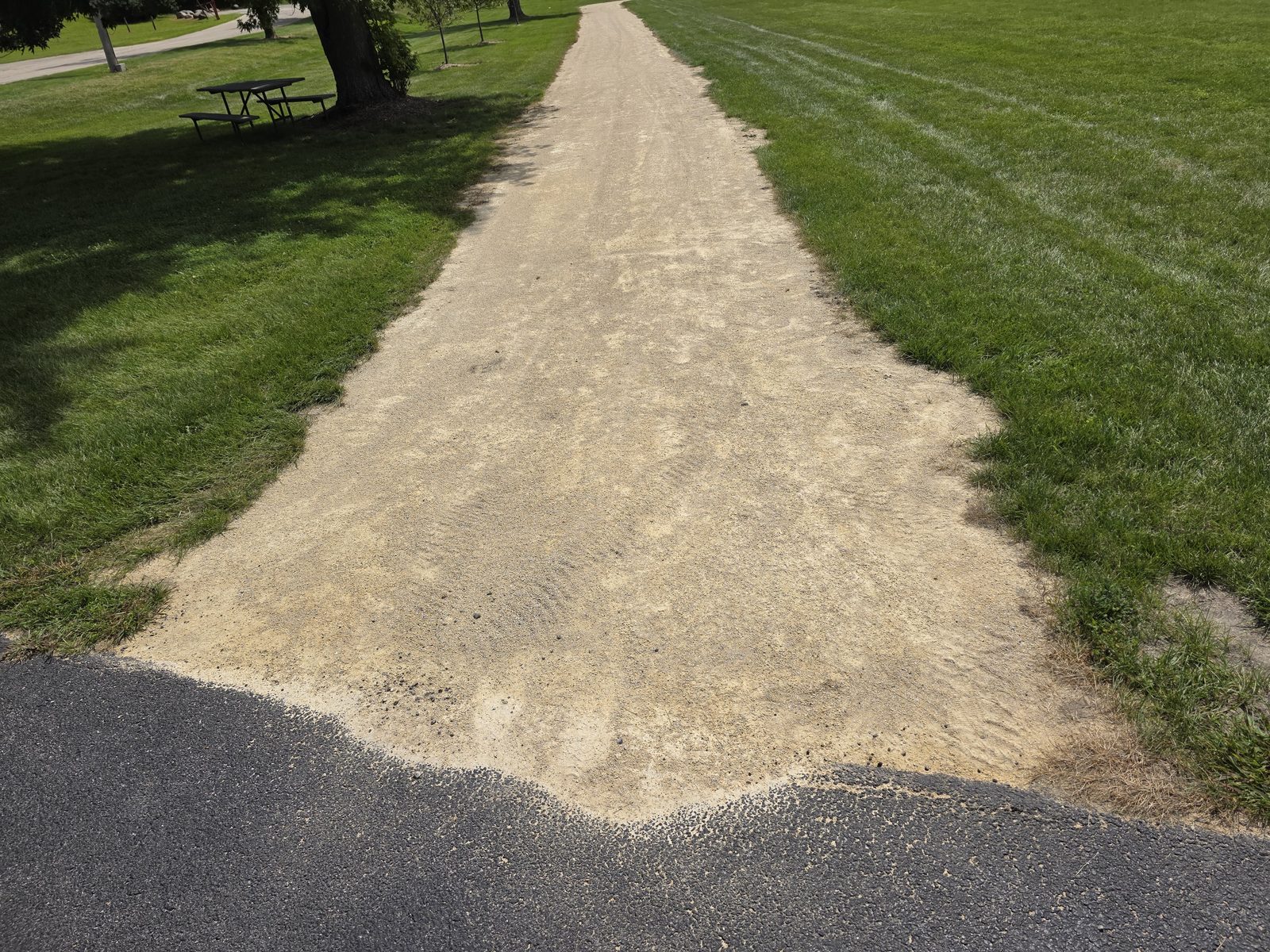
There is a new walking path at Indian Oaks Park, and by every account people like it. It runs along the western edge of the park, it is flat and open and easy to find, and it opened in time for Day in the Park on July 11. For a town this size, a new place to walk is a real thing. Nothing in this story changes that.
What follows is not about whether the path was worth building. It is about the ordinary paperwork of building it: a contract, a plan, a board vote, a competing price.
In the district's own words, almost none of it exists.
The Price
The path cost $69,300.
That figure comes from three invoices from Doug Kunde Excavating, all dated June 30, 2026, all billed to the park district, and numbered in sequence:
- #9646, lime screenings for the new walking path: $24,500
- #9647, excavation of the new walking path: $24,000
- #9648, dirt removal for the walking path: $20,800
Four more invoices from the same contractor, dated the same day, cover drainage work: pipe and labor along O'Connell Road, four crossings on the path, and a catch basin at the edge of the blacktop. They come to $9,200. Altogether the district paid Doug Kunde Excavating $78,500 for the project, all of it on July 30, in seven checks issued the same day.
Each invoice is a single lump-sum line. None carries unit pricing, a rate, or a breakdown of hours, tons, or square feet. The district released the first three to Marengo Weekly on July 29 in response to a public records request filed July 9, and the full set on August 28.
The money behind the project is a $100,000 state appropriation, made to the district through the Build Illinois Bond Fund and administered by the Illinois Department of Commerce and Economic Opportunity. It appears in the state's own published capital appropriation listings as a grant to the Marengo Park District for infrastructure improvements at Indian Oaks Park.
What We Asked For
On July 29, after reviewing the district's production, Marengo Weekly asked the park district for the ordinary paperwork behind that spending. Six categories. The kind of documents any public body generates when it hires someone to build something.
The district's answer to each request, on July 30, was the same four words: "No such records exist."
We put all six back to the district a second time before publishing. On August 28 it revisited one of them and stood by the other five.
| We asked for | July 30 | August 28 |
|---|---|---|
| The contract or purchase order with the excavating company | No such records exist. | Re-confirmed. No written contracts or purchase orders exist; "prior project authorizations were managed verbally." |
| The project specifications, engineering plans, or as-built drawings | No such records exist. | Re-confirmed. |
| The board resolution or ordinance authorizing the project | No such records exist. | Re-confirmed. |
| Any price quotes, bids, or proposals the district received | No such records exist. | Updated. Two written proposals produced. |
| Any written prevailing-wage notice given to the contractor | No such records exist. | Re-confirmed. |
| Any permit application submitted to the city, county, state, or a federal agency | No such records exist. | Re-confirmed. |
The two proposals both come from Doug Kunde Excavating. The first, dated October 20, 2025, offers the district a choice of two ways to build the same path: $69,242 to excavate it, or $58,190 to lay it on top of the ground without excavating. The second, dated June 18, 2026, adds $9,200 of drainage work. Each is headed "PROPOSAL/CONTRACT," and each carries an acceptance block for the district to sign. Both acceptance blocks are blank. Above them, in the contractor's own words: "WORK WILL BE SCHEDULED UPON RECEIPT OF SIGNED PROPOSAL."
So the record now holds two prices for the walking path, and both of them are the same contractor's. It holds no price from anyone else.
Two things are worth saying plainly here.
The first is that none of this is, by itself, against the law. Illinois park districts have real latitude in how they buy things, and a small district doing straightforward dirt work with a local operator is not required to run the kind of process a school district runs for a new roof. We are not accusing anyone of anything. We asked for the documents, and the district told us what it has and what it does not.
The second is that the district knows how to do this differently, because it wrote down how, and because it has.
What the District's Own Policy Required
Among the documents the district produced on August 28 is the one we had asked for first: its purchasing policy, approved by the board on October 24, 2022.
The policy sets a ladder of who may authorize what.
| Dollar amount | Authorization level |
|---|---|
| Equal to or less than $250 | Authorized Employees |
| Over $250 and up to $2,500 | Supervisors |
| Over $2,500 and up to $10,000 | Executive Director |
| Over $10,000 | Board of Park Commissioners |
The section governing that level does not treat it as a formality. It requires board approval "even if the purchase is exempt from competitive bidding."
The option the district built, the excavated one, was priced at $69,242. Three of the seven invoices are individually over $10,000. And the district's answer on whether a board resolution or ordinance authorizing the project exists, given twice now, is that no such record does.
The district also produced the paperwork it did generate. Each of the seven invoices arrived with a Marengo Park District check request form, filled in with the vendor, a one-line description, an account number, and an amount. Each is signed on the line marked "Director's Signature" and stamped June 30, 2026. The invoices themselves are addressed to Dan Bertrand, the district's director at the time. That is the whole of the approval on the face of the documents, including on the $24,500, the $24,000 and the $20,800. The form has no line for the board.
The policy has one more requirement worth setting beside the record. For any purchase over $2,500 it asks for "at least three (3) informal, written quotes," and where three cannot be had, for a good-faith effort that is "made and documented."
The District's Own Rulebook
Two years before the walking path, the same park district, under the same director, advertised for bids on the Indian Oaks Park venue project.
That notice ran in the Northwest Herald on May 3, 2024. Sealed bids, due at 10:00 a.m. on May 21 and opened one minute later. A 10 percent bid bond required. A design firm, Hitchcock Design Group, fielding bidder questions. And the district's own requirement, written into the advertisement, that the winning contractor pay prevailing wage and submit certified payrolls to the district by the tenth of every month.
That is a textbook procurement. The district wrote it, published it, and ran it.
The venue got sealed bids, a bond, a design firm, and a payroll rule. The walking path got two proposals from one contractor, seven invoices dated the same day, and, by the district's own account, no contract, no plan, and no board resolution.
The Permits Question
The state grant application contains a line worth reading closely.
In the project narrative, the district was asked whether it had secured all necessary federal, state, and local permits and approvals. The application says "Yes."
Two officials signed the application's certifications. The authorized representative block carries the signature of Park Director Dan Bertrand, dated June 10, 2026. The certification page, signed under penalty of perjury, carries the signature of board President Marty Mohr, dated June 25, 2026, the same day the district posted that work on the path had begun.
The district now says it never applied to anyone for a permit.
We asked the district what that "Yes" was based on. Its August 28 answer is that the certification "pertained to the internal district authorizations and project scope approvals required by the Park District prior to grant submission," and that the signatures "reflected the administrative understanding at the time that all necessary prerequisite internal permissions and district scope reviews had been satisfied."
The same letter says no board resolution or ordinance authorizing the project exists, and no permit application was submitted to anyone.
Those statements sit uneasily together, and we want to be careful about what that does and does not mean. "All permits secured" and "we submitted no permit applications" can both be true if no permit was required. That is the open question, and it is not ours to answer.
So we asked the bodies that would know. McHenry County's Department of Planning and Development answered on July 30: it has no records for the project, because the property sits inside the City of Marengo, which administers its own stormwater permits as a certified community. The question pointed at city hall.
City hall answered the same day. Asked for any stormwater management permit issued for the project under the city's code, the city's answer was two words: "No permit." Asked for any building, grading, or land-disturbance permit, the answer was the same two words. And the city confirmed in writing what the county had said, that it is a certified community administering the McHenry County Stormwater Management Ordinance inside its limits, which makes it the one local body that would have issued a permit for this project if one had been sought.
The ordinance the city administers sets a specific trigger: a project needs a stormwater permit when it disturbs 5,000 square feet of ground or more. The district's own grant application describes the path as 4,000 feet long. At that length, the project would cross the 5,000-square-foot line if the disturbed ground averaged just 15 inches wide. Marengo Weekly walked the path on August 25 and found it nowhere narrower than four feet. Four thousand feet at four feet is 16,000 square feet, and the measure is disturbed ground rather than the finished surface: excavating and grading a path disturbs at least the width of the path itself.
That completes the record. The application told the state every necessary permit and approval was secured. The district says it never applied for one, and that the certification referred to its own internal approvals. The city that issues permits says none exists, and the county behind it says the same. Whether this particular project required a stormwater permit is a determination the ordinance leaves to the city, and it is a determination the city was never asked to make. What the documents establish is simpler: there is no permit anywhere in the record behind the word "Yes."
What the Grant Was For
The path is not the whole grant.
The district's own budget, submitted with its application, divides $120,058 across three lines. Two of them match the Kunde invoices to the dollar: $24,500 for paving and masonry is invoice #9646, and $44,800 for excavation and site prep is invoices #9647 and #9648 added together. The third line, $50,758 for equipment, materials, and labor, is what the application's narrative describes as a playground. That is a separate piece of the same grant and it is not part of this story.
What the budget does not contain is just as clear. There is no money in it for design, none for engineering, none for construction management, and no contingency. Every dollar goes to material and machine work. The district's own summary tab totals $100,058 against a $100,000 grant, a $58 arithmetic discrepancy.
The path's end, where the lime screenings meet the parking lot asphalt with no header or edge detail. Photographed by Marengo Weekly, August 25, 2026.
Where the Dirt Went
One line in the project has an answer now that it did not have a month ago.
Invoice #9648, the $20,800 one, reads "dirt removal for the walking path." Walking the path on August 25, Marengo Weekly noticed mounds of bare soil lying along the tree line at the edge of the field, at several points beside the path. We asked the district whether that was the material excavated for the path, and whether placing it there is what the invoice covers.
The district's answer, on August 28: "Yes, Invoice 9648 covers the placement of excavated path soil along the wood line. Staff are evaluating the area for future grading and redistribution as standard post-construction protocol."
The contractor's October proposal describes the same arrangement in advance. The option the district took reads: "EXCAVATE for 4000' x 8' x 6" walking path. Haul dirt on site."
The Money Has Not Moved
One more fact, from a source that has nothing to do with the park district.
The Illinois Comptroller publishes every payment the state makes. Searched against the district as payee, across every fiscal year available, not one dollar of the $100,000 Indian Oaks grant has been disbursed.
That is not automatically strange. Capital grants of this kind are often reimbursement grants, which means the grantee builds first and bills the state after. But it does mean the district built the path, and Kunde invoiced for it, with none of the grant money in hand.
It also raises a timing question. State rules do not allow grant funds to be spent before a grant agreement is executed, and no executed agreement appeared in what the district produced.
So we asked the state. The Department of Commerce and Economic Opportunity, which administers the money, told us on August 25 that no grant has been issued to the Marengo Park District for $100,000. An earlier letter from the Department, on August 4, said the notice of state award for this project has not yet been issued.
The district does not dispute any of it. Asked to respond, it wrote on August 28 that it "acknowledges the record" from the Department and the Comptroller's ledger "indicating that no grant agreement has been executed and no state funds have been disbursed to the District for this project to date," and confirmed that "zero grant funds or state reimbursements have been received or deposited into District accounts for the walking path construction." It says it is tracking the application with state officials.
The appropriation itself is real and public. It sits in the Department's own capital appropriations listing, $100,000 from the Build Illinois Bond Fund for infrastructure improvements in Indian Oaks Park. What has not happened is the step that turns an appropriation into money a grantee can draw.
We also asked the Department whether it holds any written approval of pre-award costs, the mechanism that lets a grantee spend ahead of an agreement and still be reimbursed. It answered that it is not in possession of records responsive to that request. That is a statement about the Department's records, not a finding about the district.
Which leaves the sequence, on the record as it stands, as this. The General Assembly set the money aside. The state has not issued the award or the agreement that would release it. The district built the path in June, Kunde invoiced for it on June 30, and the district paid all seven invoices out of its own funds on July 30.
The Bills
The district's accounting records show all seven Kunde invoices entered as bills on July 1 and paid on July 30, in seven checks numbered #6398 and #6412 through #6417.
The district says the action on those bills is recorded in the minutes of its July 30 meeting, and that those minutes were approved at the board's regular meeting on August 27.
One thing we asked about turns out not to be a question. The district's Budget and Appropriation Ordinance for the 2026-27 fiscal year, ordinance 2026-003, was adopted on February 19, 2026, not in July. State law lets a park district adopt it within or before the first quarter of the fiscal year, and the district's fiscal year began May 1.
What This Is, and What It Isn't
This is not a story about a bad path or a stolen dollar. The path exists, people are using it, and every invoice the district has produced reconciles to its own budget to the penny.
It is a story about a public body that spent $78,500 on a project its own purchasing policy put in the hands of its board, and that can produce no contract, no plan, and no board authorization for it, and that told the state it had secured permits it never applied for. It is about a district that ran a clean, published, bonded procurement in 2024 and then, fourteen months later, did none of that.
Small districts run on trust and volunteer hours, and there is no evidence anyone here set out to hide anything.
The record behind this story came in three deliveries, and they did not come at the same speed.
Marengo Weekly filed the original request on July 9. State law gave the district five business days. On July 13 the district asked for more time without naming a new date, so we proposed July 24 in writing, and got no reply to that either. July 24 came and went with nothing. We followed up on July 27, and the district committed to producing what it had by Wednesday morning. Wednesday morning passed. The first delivery came Wednesday evening, thirty-nine scanned pages, twenty days after we asked.
Reading it, we asked on July 29 for the six categories of paperwork it did not contain. That answer arrived the next morning: no such records exist, six times over.
We put all six back to the district on August 4, together with the rest of the questions in this story, and the district asked for until August 30 to answer them. It answered on August 28, two days early, with a signed three-page letter and five exhibits: the purchasing policy, the two proposals, all seven invoices and the check requests behind them, the payment ledger, and the budget ordinance. Most of the documents quoted in this story came from that third delivery.
The first delivery came under the district's previous director. The third came from the interim director appointed in July.
"We did not write it down" is not a small thing when the money is public.
It matters more than usual right now. The park district is carrying a second, much larger grant for another path project at the same park, this one federal, and that work has not started.
What the District Says
The park district answered every question in this story.
Amanda Damisch, who became interim director in July and serves as the district's FOIA officer, replied three times over those three weeks and asked for the questions in one consolidated list so the district could answer as comprehensively as possible.
The district's own account of what happened is that the paperwork was not there and it knows it. Under new interim leadership, its letter says, the district has "taken immediate steps to clean up past record-keeping practices, tighten administrative controls, and ensure all district operations follow clear, proper protocols moving forward." It describes the earlier approach in its own words: "prior project management relied on verbal authorizations that didn't meet the standards our residents expect."
It also says the path is worth having. "The walking path itself is a great addition to Indian Oaks Park. It gives our community a solid, 4,000-foot loop built with a lime screening surface, complete with new drainage infrastructure to make sure it lasts."
All seven check requests behind the project carry the same director's signature, dated June 30, 2026. The director who signed them left the district on August 3.