Government
Marengo Once Counted Part of Itself. That Option Is Gone.
The short version: On March 30, 2006, the Census Bureau counted 1,732 people in Marengo. Not the whole town, just part of it. Under the rules of that decade a city could ask the federal government to recount only the blocks where something had changed, and Marengo did. It cannot make that request today, and the reason has nothing to do with anything the city did. A rule that arrived with the 2020 census requires a town to contain at least one whole census tract before it can ask for a partial count. Marengo sits inside two and fills neither, which puts it with 87.9% of Illinois municipalities.
Thursday, August 27, 2026
On March 30, 2006, the U.S. Census Bureau counted 1,732 people and 591 housing units in Marengo. Not the whole town. Just part of it.
The city was growing then, and under the rules of that decade a municipality could ask the federal government to go back and recount only the blocks where something had changed. Marengo did. The count is still in the Bureau's published record of official special census results, in the column headed "Full or Partial Special Census," with one word next to Marengo's name: Partial.
Marengo cannot make that request today. It is not because of anything the city did or failed to do.
What a Special Census Is For
Between the once-a-decade national counts, a local government can pay the Census Bureau to count it again. The result becomes the community's new official population, and official population is not just a number on a sign.
Illinois sends municipalities several streams of state money on a per-resident basis. The two largest are the local share of state income tax collections, distributed through the Local Government Distributive Fund, and motor fuel tax allotments. The Illinois Municipal League's current per-capita estimates put all of those streams together at roughly $240 a resident a year.
State law is unusually direct about where the population figure comes from. The motor fuel tax statute apportions the municipal share "in proportion to the population of such municipalities as determined by the last preceding municipal census if conducted by the Federal Government or Federal census." A municipal census conducted by the federal government is a special census. The mechanism this article is about is named in the statute that moves the money.
Urbana ran a partial special census in late 2024, and what it did with it shows what the tool is for. The city's 2020 count had come in lower than expected, and city officials attributed that to timing, since the 2020 census was taken two weeks after the University of Illinois sent students home at the start of the pandemic and the shortfall showed up near campus. So Urbana recounted that area and nothing else. The blocks inside it went from 7,146 residents to 9,605, the city's official population rose from 38,336 to 40,795, and Urbana said the difference was worth about $600,000 a year to its general operating fund and motor fuel tax fund.
The municipality pays for the count. The Bureau does not publish a price for the current program and prepares every estimate individually, but its own sponsor guide reports what the last round cost: in the 2010 program the median special census ran $113,000, and the full range ran from $14,000 to $4 million.
That median comes with a detail worth holding onto. The median special census in the 2010 program covered 1,600 housing units. That is a piece of a town, not a town. Marengo has 3,091.
How It Used to Work
Under the program that ran through the 2010s, a partial special census was drawn at the level of the individual census block. A town could point at the subdivision that had gone up since the last count, ask for that, and leave the rest of the town alone.
Illinois municipalities used it heavily. In 2006, 42 special censuses were completed in Illinois, by 38 different governmental units, and 36 of the 42 were partial counts. Several towns ran a count and then came back the same year for a single block. The Bureau's table lists them under names it made no attempt to dress up:
- St. Joseph (One Block), 33 people
- East Peoria (1 block), 81 people
- Bryon (1 Block), 136 people, the Bureau's own spelling of Byron
- Carol Stream (3 Blocks), 605 people
A 33-person federal census. Small communities were the heaviest users, and the counts were small because the areas were: Hudson's partial count came to 363 people, Northfield's to 398, Dunlap's to 612, Kirkland's to 795. Marengo's 1,732 was on the larger side of the middle.
There is a reason the block-level version mattered to towns that size. A partial count only covers the blocks inside it, and everywhere else keeps the population it was assigned at the last national census. A town recounting three new streets was not putting the rest of itself on the table. A full count is the opposite, and takes the whole municipality in whichever direction the counting comes out.
What Changed
The 2020 census brought a new system for protecting the confidentiality of the people counted. The Bureau has guarded against published statistics identifying individual households for decades, but the method it adopted for 2020 was a different and more mathematical one, and it carried over to the Special Census Program. From the Bureau's 2020 Special Census Program Sponsor Guide:
The 2020 Census disclosure avoidance methodology will be used with a few changes for the Special Census Program. As such, the minimum statistical area for which any partial special census can be conducted is a 2020 Census tract. This is different from the 2010 Special Census Program where partial special censuses were delineated at the block level.
And the sentence that decides who is in and who is out:
GUs that do not contain a complete tract are not eligible for a partial special census and must conduct their special census for their entire GU.
"GU" is the Bureau's shorthand for a governmental unit, meaning the city, village or county doing the asking.
The rule is easy to misread, and the way it actually works matters. It is not that a town can no longer have a single block counted. It is that a town now has to clear a threshold before it can ask for a partial count at all: somewhere inside its borders there has to be one entire census tract. Clear that, and the area actually counted can still be drawn finely. When Urbana ran its partial in 2024, the Bureau enumerated 60 individual blocks spread across six different census tracts, most of them only partly covered.
So the block-level count did not disappear. The door to it did, for any town that does not have a whole tract inside it.
One more restriction came with the change: any given ground can be included in a special census only once between 2023 and 2028. A town can request more than one partial count, but not of overlapping areas. For a community that has to count all of itself, that makes the count a single shot for the life of the program.
Marengo Weekly asked the Census Bureau to confirm its reading of the rule before publishing. In an August 20 response attributable to the Bureau, it did, and addressed Marengo directly: "based on our current records of the city's boundaries, Marengo, IL is only eligible for a full special census." The Bureau also confirmed that, with the city's current boundaries, Marengo could not repeat what it did in 2006.
Why Geography Decides This
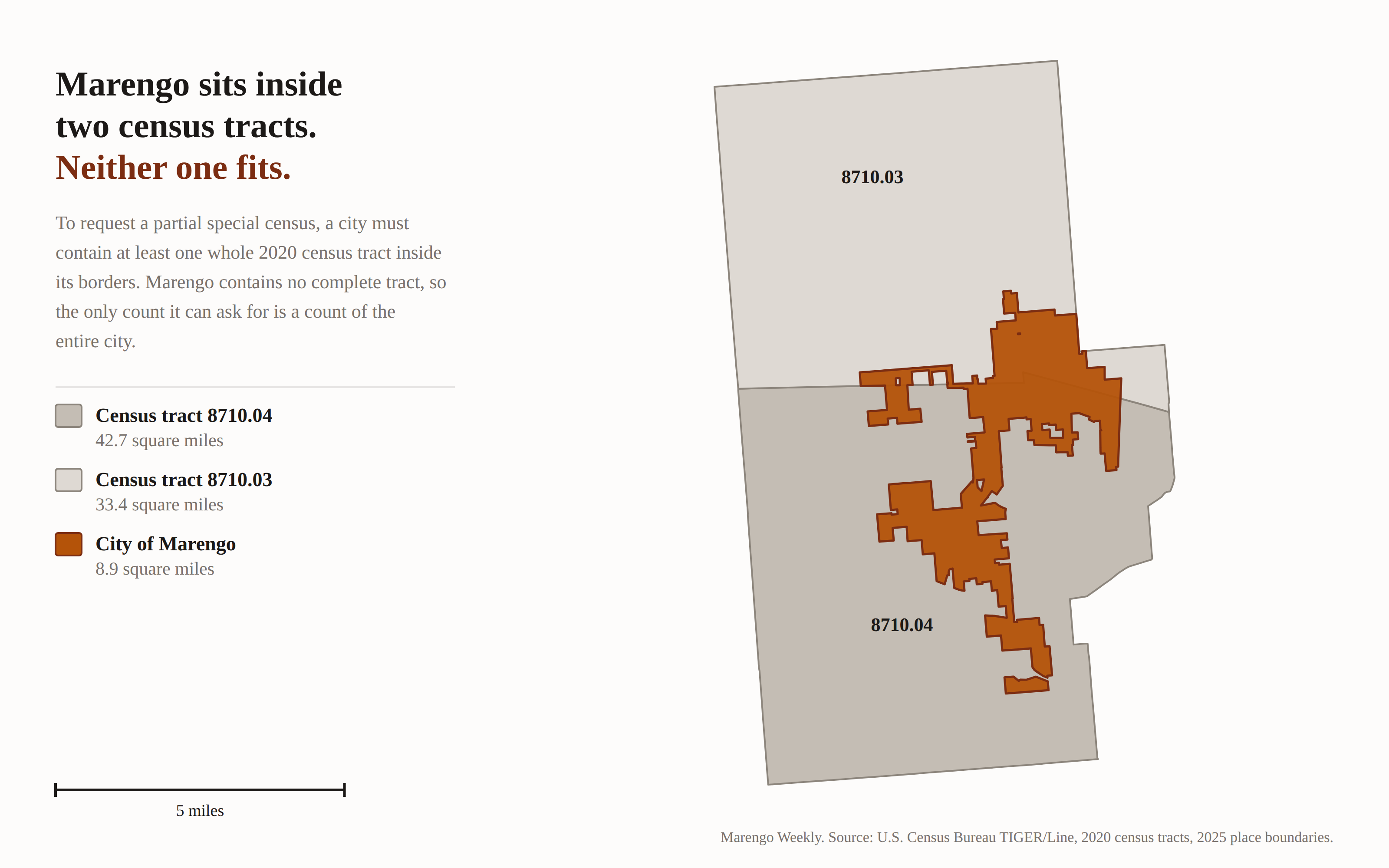
Marengo's city limits against the two 2020 census tracts that contain it. A partial special census requires one whole tract inside the city. Neither fits.
A census tract is drawn to hold a target number of people, not to cover a set amount of ground. In a dense place a tract is a few blocks. In farm country it is enormous.
Marengo's roughly 8.9 square miles sit inside two tracts. Tract 8710.04 covers 42.7 square miles and tract 8710.03 covers 33.4. About 15% of the first and 7% of the second fall inside the city limits, so neither is close to fitting.
The Bureau noted one path back to eligibility, which is annexing the remainder of either tract. The remainder of the larger one is about four times the size of the entire city, so it describes the arithmetic rather than a course of action.
Marengo Is Not Unusual
To see how many Illinois communities are in the same position, Marengo Weekly compared the Census Bureau's current municipal boundary files against its 2020 census tract map, checking every city and village in the state for a tract that fits entirely inside it. The results were then checked a second way, against the Bureau's own record of which blocks sit in which tract and which municipality.
Of the 1,292 incorporated Illinois municipalities with a 2020 population, 156 contain a whole tract. The other 1,136, or 87.9%, do not, and can only ask for a count of the entire community.
The split falls along size, but not quite the way it looks. Among municipalities under 10,000 residents, 1.4% are eligible for a partial count. Above 50,000, it is 93.3%. The thing actually driving it is density rather than population, because tracts are sized by people and not by acreage. Stone Park qualifies with 4,576 residents packed into a third of a square mile. Plainfield, with 44,762 residents spread across 26 square miles, does not.
What has actually happened in Illinois is consistent with that. Eight special censuses have been completed under the current program, seven of them by municipalities and one by McDonough County, which as a county contains whole tracts automatically. Every one of the six municipalities that ran a full count is one that could not have asked for a partial. The only municipal partial count in the state is Urbana's, and Urbana contains four whole tracts.
One thing the record does not support is blaming the rule for the decline in special censuses generally. Illinois had 42 in 2006 and exactly one in 2018, and that drop happened years before the tract rule existed. The rule changed what kind of count a town can request, not how many towns want one.
What Marengo Has Now
The program is open. The Bureau accepts cost estimate requests through May 2027 and finishes collecting data in September 2028, ahead of the 2030 census that resets every community's count anyway.
What Marengo can request is a count of the whole city, which would replace its certified population in whichever direction the count came out, and which it could only do once.
Three Illinois towns close to Marengo's size tried it in 2025. West Dundee went from 7,686 to 8,372, Volo from 6,122 to 6,810, and Hampshire from 7,667 to 9,425. All three gained, and all three had been adding residents through the 2010s, which Marengo had not. Some of what a full count picks up is annexed ground rather than new neighbors, because the count uses the boundaries the town has on the day it is taken.
A count is not an estimate, though, and the two do not track. The Bureau had estimated Volo at 7,361 for 2024; its special census came back at 6,810, about 550 lower. West Dundee and Hampshire both came in several hundred higher than their estimates. Marengo's current estimate is 7,699, which is 131 above the 7,568 the state certifies and pays on.
In 2006 the city could ask about just the blocks where the houses were going up. That is the part that is no longer on the table.