Meeting Recaps
Marengo, IL City Council Recap: September 14, 2026
The short version: For the first time since June, Marengo's city council split. A Grant Highway property headed for a small grocery was rezoned 5 to 1 and got its six variances 4 to 2, after council members argued over whether the variances were the right tool. The Chamber's Settlers' Days beer tent passed 5 to 1 after a question about what the event costs the city. And a new $63,975.62 utility truck will finally carry a utility box the city bought years ago and never put on anything.
Tuesday, September 15, 2026
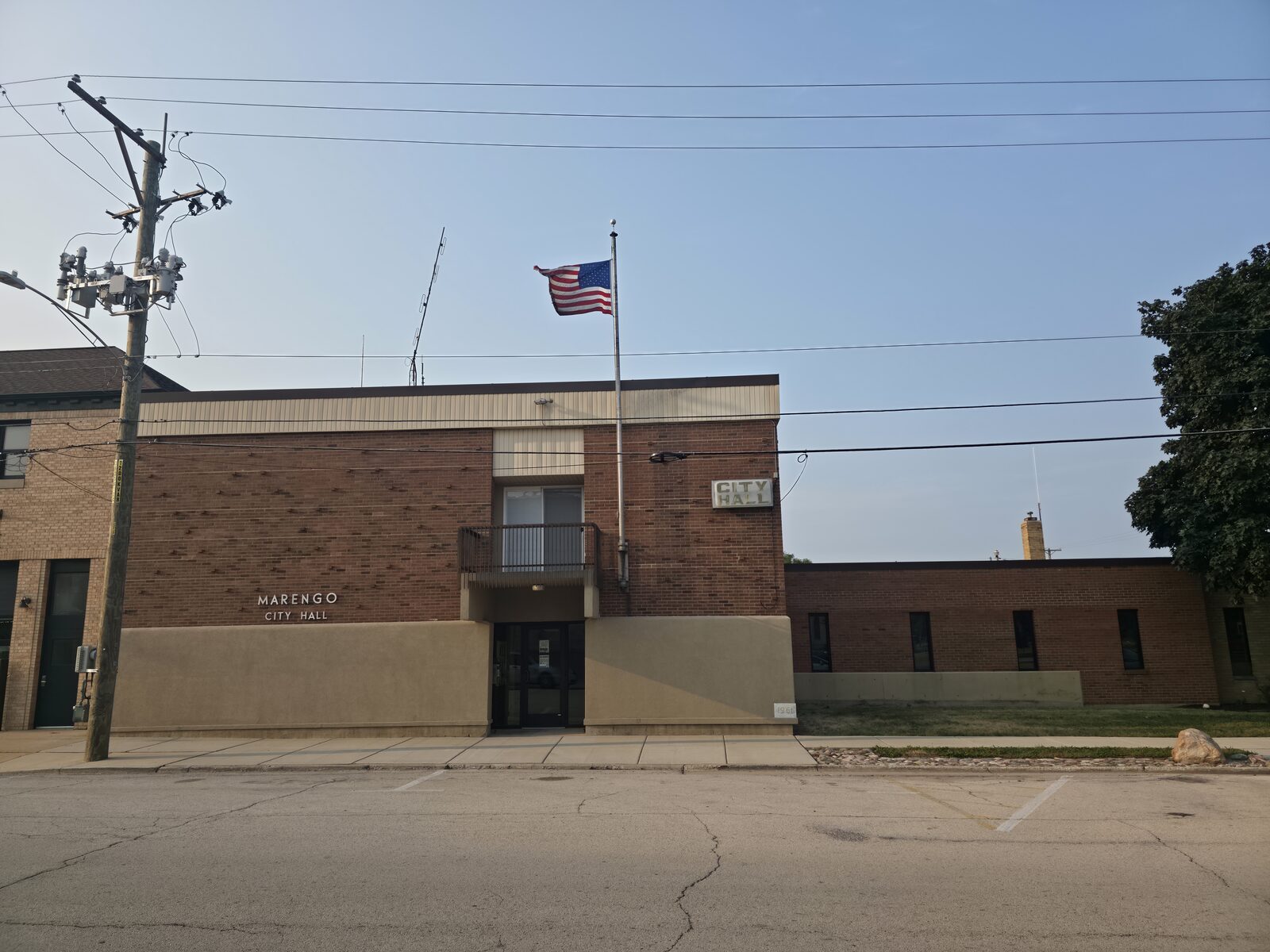
Marengo's city council, which has passed nearly everything in front of it unanimously since spring, split three times Monday night. Two of the splits were on one property: a small commercial building at the corner of Grant Highway and Maple Street, a former gas station on land the city zones for single-family houses, that a new owner wants to run as a small grocery. The rezoning passed 5 to 1 and the six variances that go with it passed 4 to 2, after a debate over whether the council should rezone the lot at all or grant the variances on a clock. The third was the Marengo-Union Chamber of Commerce's Settlers' Days beer tent, which passed 5 to 1 after a council member asked what the event costs the city and staff put the figure at somewhere between eight and fifteen thousand dollars a year.
The council also authorized a $63,975.62 Ford F-450 for the utilities division, a truck whose main job is to carry a utility box the city bought several years ago and never mounted on anything. It approved a parking lot enforcement agreement with the elementary district, declared a 23-year-old Chevrolet Blazer surplus, heard the first-quarter budget report, and talked through a rewrite of the rule on dumpsters at houses that it will take up again as an ordinance. Six of the council's eight members were present. No one spoke during the public comment period at the top of the meeting.
On the consent agenda, the council approved the August 24 minutes and a $209,158.49 list of bills.
A Grocery on Grant Highway, and Whether to Rezone for It
The property is 605 East Grant Highway, the southeast corner of Grant and Maple. The agenda listed it as 650; City Administrator Derik Morefield corrected the address before the motion. The lot is zoned R-3, one family residential, but the building on it is not a house. At the August planning hearing the petitioner described it as a former gas station with the tanks removed, and it has been used as a business for decades, on special use permits rather than under the zoning. A permit for offices in a residential district was granted in 1978, expired in 2003, was reinstated in 2009 after the lapse was discovered, and expired again in 2019. Nothing has covered the use since. The county planner's report, repeated in the city administrator's memo, says it is unclear how, but the property stayed in non-residential use after that. The Planning and Zoning Commission heard the case on August 17 and recommended approval 5 to 0.
The owner bought the building in February and wants to open a market. Because the 2025 comprehensive plan identifies the property for commercial development, staff steered the request toward a rezoning to B-2. The catch is that a decades-old building on a 13,199-square-foot lot does not fit B-2's bulk rules, so the rezoning came paired with six variances: lot size (15,000 square feet required), lot width at the building line (100 feet required, 82 there), front setback (50 feet, 31 there), corner side setback (50 feet, 5 there), side setback (25 feet, 9.5 there), and the setback from a primary thoroughfare, which the code sets at 150 feet from the centerline of the road or 75 feet from the property line, whichever is greater, and which is 64 feet from the centerline here. Nothing about the building's footprint changes. The petitioner's representative told the council the work inside would be interior only, that the family intends to run the business themselves rather than rent the space, and that the paperwork "wasn't too bad" for a contractor used to pulling building permits.
The debate on the dais was about the tool, not the grocery. One council member said that as much as they would like to see something go into the building, "six variances is an awful lot," and asked whether the council had the option of rezoning the property without granting them. Others on the dais said the real problem is the lot itself, an odd shape that the building probably violated when it was built. The city's attorney said the council could put conditions on the variances, including a time limit that would force a future council to look at the property again, and added that he had never seen that done. Asked whether the city has other properties like it, City Administrator Derik Morefield said the council was likely to see many more requests like this one, because the comprehensive plan shows the Grant Highway corridor as commercial and the corridor is full of old houses on small lots. A council member asked whether Marengo could adopt something like the approach used in the Dundee area or Huntley, where old homes have become businesses. Morefield said that would probably mean an overlay district, and that Marengo's zoning is checkerboarded enough to make one hard to draw.
The rezoning passed with five members voting yes and one voting no. The variances passed 4 to 2; the member who voted against the rezoning also voted against the variances, and a second member joined them. The business still needs its building work reviewed and a business registration before it opens.
Settlers' Days, and What the Evening Costs
The Chamber asked for a special event liquor license for its beer tent at 100 West Washington Street during Saturday Night on Main Street, October 10, from 5 to 11 p.m., and for city personnel and services: barricades, road closures and a police presence through the evening. Its letter says the Settlers' Days committee will provide meal vouchers to the city workers and police officers assigned to the event.
A council member asked what that costs the city. Staff said the city has tracked its services for the event in past years and the all-in cost, public works and police together, has run anywhere from about $8,000 to $15,000. Staff also explained why the license was in front of the council at all. Special event liquor licenses have not historically come to the council, but the code says a special event that uses city streets or other public property needs council approval, so the Chamber was asked to come back for it. Next year the Chamber's usual March letter will bundle the license and the services request into one package.
The motion passed 5 to 1. The member who voted no was the one who had asked about the cost.
A Truck for a Box the City Already Owns
The council authorized the purchase of a 2027 Ford Super Duty F-450 for the public works utilities division, $63,975.62 through the Sourcewell cooperative contract from National Auto Fleet Group. The packet lists the manufacturer's price at $66,120.00, a savings of $2,144.38. Because the purchase runs through the cooperative contract, the competitive bidding was already done.
The point of the truck is a utility service box, an enclosed body full of tool compartments, that the packet says the city bought several years ago and has not yet put on a vehicle. How that happened came out on the floor. Public Works Director Tyler Ankney told the council that roughly three years ago the council approved a 450 with the box on it, the box was bought separately, and for reasons he did not know the truck order was cancelled. The box sat at the manufacturer for about three years; past city employees tried to get the manufacturer to resell it, without success, and the city picked it up recently. Asked whether the city had paid storage fees, he said it had not. Asked whether the city had bought another truck in the meantime, he said it had not.
A council member asked how many pickups the city has now; Ankney said he would get the number. The same member noted that a previous public works director had the city buy a box trailer for the same purpose of carrying tools to a job. Ankney said the trailer is still in use, mostly for shoring equipment, and that the plan is to tow it behind the new truck when needed. The truck itself will be stocked with the parts a water main break needs, valves and b-boxes and hardware, so that a crew does not diagnose a problem and then drive back to the plant for the part.
Morefield told the council the city is coming up on its capital improvement plan season and that a draft with a vehicle and equipment replacement program will come to the council around November. Ankney, he said, was a fleet manager in his previous job, and the replacement list will weigh service records and hours rather than mileage alone. Asked whether this pickup was in the last CIP draft, staff said a replacement was on the list but was budgeted to the general fund, not the water and sewer fund; the plan had been to shift an existing vehicle over, and the box needed a truck that could carry it.
School Parking Lots
The council approved an agreement with Marengo-Union Elementary Consolidated District 165 for parking lot control on district property. The chief said the city has had a similar agreement with the high school. Chief of Police Andrew Kjellgren said the agreement is not really about parking. It lets officers take enforcement action in the district's lots for crashes and reckless driving, rather than only noting them, and it was requested by the district's superintendent. A council member said they could see the need on student lots but not on staff lots; the chief said the issue has been more common at the high school, with student drivers and the access road, while the elementary district's concern is drop-off and pick-up. The vote was unanimous.
The Blazer
The council declared a 2003 Chevrolet Blazer surplus. The public works memo puts it at about 74,600 miles and 23 years old, with a brake control module that needs replacing at an estimated $642 to $1,717. Staff expect it to bring $600 to $1,000 at a government surplus auction sold as is, and did not think the repair was worth it. A council member asked how fast the city could get rid of it. Staff said it would go on the auction site right away, that it runs but has problems, and that the problems have to be disclosed to bidders.
First Quarter Budget
Assistant City Administrator Megan Lopez presented the first-quarter report for the fiscal year that began May 1. General fund revenue through July was $2,583,298.36, or 38.25 percent of the year's projection, which is above the 25 percent a quarter would suggest because property tax comes in during the summer and fall; property tax alone was at 55.20 percent. General fund spending was $1,160,741.16, or 17.19 percent. The streets department was at 10.25 percent because its biggest line, the road resurfacing paid for with the one percent non-home-rule sales tax, has not been spent yet; the memo expects that by the third quarter. Water and sewer revenue was at 25.55 percent of projection and expenses at 19.87 percent.
Lopez also told the council the police pension investments are now reported at market value, which includes gains and losses the fund has not realized, and that unrealized gains are not cash the city can spend. Morefield asked her to explain for the audience why property tax runs ahead of the calendar; she said the county distributes the city's share from June through November, with the last payment near the end of November.
Dumpsters at Houses, Again
The one discussion item was the refuse container rule the council first took up on August 10 and pulled out of the nuisance ordinance on August 24. The August version would have barred commercial dumpsters at residential properties with fewer than four units. The new draft allows one: a dumpster of no more than two cubic yards, on wheels, watertight and covered, kept behind the building setback line, on concrete, asphalt, brick or pavers, inside a screening enclosure no taller than six feet, used only for that property's own refuse. Dumpsters larger than two cubic yards would not be allowed for ongoing collection at those properties, and roll-off containers could be placed only temporarily, for construction, remodeling, demolition or a cleanout, with the city's approval.
Morefield said the draft tries to honor two things the council asked for last month, a limit on commercial dumpsters in neighborhoods and an allowance for the residents who told the council they already have one, and he asked the council to send it back with changes, bring it back as an ordinance, or drop it. A council member asked whether the draft's reference to the city's residential refuse contract could ever be used to keep a homeowner from getting a dumpster from a different hauler, and asked staff to pressure-test the reliance on a contract that will be bid and negotiated again.
That question led to another. A council member asked when the city's garbage contract expires. The answer from the dais was 2029, possibly 2030, most likely 2029. The member suggested the city plan for the bid now, and said that the last time around the contract did not go out to bid. Morefield said the next one will not be tight, that the city will run a bid with its own specifications and take input from residents, and that residents often ask for a sticker program for low-volume households. In a community he worked for previously, he said, none of the haulers that bid would offer one; Marengo can still write it into the bid and see what comes back.
Two residents spoke on the item. One asked what benefit the city gets from contracting with a garbage hauler at all, and said the city was interfering in private business and should stick to roads, sewers, streets and sidewalks. The answers from the dais were that one hauler means one set of trucks on residential streets instead of several, and that bidding on behalf of the whole town gets a rate a single household could not. The other said that as a business owner they had once been quoted a third of their hauler's price by two competitors, and asked whether they could still do that. Staff said the city's contract covers residential pickup only and the city does not control commercial hauling. The council's reaction was that the new draft was a workable compromise, and under the path Morefield laid out that means it comes back as an ordinance.
Around Town
- The police department's newest officer passed the academy and received state certification, and has started his training with the department. The next entry-level test is Saturday, September 19. The chief said the number of applicants was lower than hoped and that the department is looking at ways to widen the pool.
- The city is accepting applications for street maintenance workers.
- Citywide fall brush collection runs Monday, September 21 through Friday, September 25. The city's notice says brush should be at the curb by Sunday, September 20, stacked loose and parallel to the road, limbs no more than six feet long and two feet across, not tied, bundled or bagged, and kept clear of mailboxes, hydrants and utility poles. Firewood, logs, pressure-treated lumber, stumps, root balls, vines, poison ivy, shrub clippings, leaves, grass clippings, fencing and whole trees are not accepted. Crews go street by street and do not come back once a street is done.
- The sanitary sewer lining project is wrapping up its cleaning and televising phase, and the contractor had ten liners installed as of Monday, according to a representative of McMahon Associates, the city's engineering firm. Resurfacing of Meyer Road, the paving that follows the first phase of the water main work south of town, and Schroeder Asphalt's 2026 pavement maintenance program on the avenues and West Railroad Street are both expected to start within the next two weeks.
- Asked whether the contractor on the first phase of the water project had wrapped up its punch list, the answer from the dais was that the city is "going to have to be having a conversation about that," and the subject was left there.
- The McHenry County treasurer's office is holding a property tax workshop at the Marengo Park District, 825 Indian Oaks Trail, on Tuesday, September 29 at 6 p.m., open to the public. A council member announced it from the dais.
There were no mayor's statements. The council closed the meeting by going into executive session on potential litigation, and took no further action in public.
The council's next regular meeting is September 28. Agendas and packets are posted at cityofmarengo.com before each meeting.